In the cold, grey twilight of the early medieval North, a solitary figure wearing a wide-brimmed hat and a traveling cloak walks along the boundary of the nine realms. Balanced upon his shoulders are two sleek, pitch-black birds. At dawn, they spread their wings and take flight across the skies of Midgard; by evening, they return to perch beside his ears, whispering secret news of battles, weather, kings, and fate.
The figure is Odin, the Allfather, and his feathered emissaries are Huginn and Muninn.
Among all the divine beasts of Scandinavian lore—from the giant wolf Fenrir to the eight-legged steed Sleipnir—none possess a closer personal connection to the chief deity of Asgard than these two ravens. Translating from Old Norse as "Thought" and "Memory," Huginn and Muninn are far more than trained animal scouts or decorative companions. They represent direct projections of Odin's cosmic consciousness, operating as the sight and hearing of a god whose relentless pursuit of wisdom demanded eternal vigilance across the cosmos.
In this comprehensive guide, we will analyze the primary literary sources preserving the ravens, explore archaeological finds across Northern Europe, dissect the psychological and shamanic roots of their names, evaluate modern academic debates, and discover why these iconic birds still captivate our global imagination today.
1. Etymology and Meaning: Deciphering Thought and Memory
To understand the core identity of Huginn and Muninn, we must first turn to the Old Norse language. The names given to Odin's ravens were chosen with deliberate philosophical intent, reflecting key dimensions of human and divine cognition.

Huginn and Muninn
+-------------------------------------------------------------------------+
|                  ETYMOLOGY OF ODIN'S RAVENS                             |
|                                                                         |
|  [ HUGINN ]  ---> Derived from *Hugr* (Mind, Thought, Desire, Soul)    |
|                   Cognitive processing, intellect, & intentionality   |
|                                                                         |
|  [ MUNINN ]  ---> Derived from *Munr* (Memory, Emotion, Mind's Desire)  |
|                   Preservation of past lore, identity, & tradition     |
+-------------------------------------------------------------------------+
Huginn: The Speed of Intellect (Hugr)
The name Huginn derives from the Old Norse noun hugr, which translates to "thought," "mind," "courage," or "intellect." In Scandinavian folk tradition, hugr was also viewed as a semi-autonomous soul-part that could leave a person's body during trance or sleep to travel across vast distances. Thus, Huginn embodies active perception—the outward projection of divine thought analyzing the current state of the world.
Muninn: The Anchor of Tradition (Munr)
The name Muninn stems from the Old Norse word munr, meaning "memory," "mind's desire," or "passion." While Huginn probes the active present, Muninn holds fast to the past. He represents the preservation of sacred history, runic wisdom, ancestral lineage, and ancestral pacts.
Together, Thought (Huginn) and Memory (Muninn) form an indivisible duality. Without active thought, memory becomes static; without memory, thought loses its context and direction.
2. The Primary Literary Sources: What Do the Ancient Eddas Reveal?
Our physical knowledge of Huginn and Muninn rests primarily upon three 13th-century Icelandic literary compilations: the Poetic Edda, Snorri Sturluson’s Prose Edda, and the Heimskringla.
                            PRIMARY LITERARY SOURCES
                                       |
    +----------------------------------+----------------------------------+
    |                                  |                                  |
Grímnismál (Poetic Edda)            Gylfaginning (Prose Edda)          Ynglinga Saga (Heimskringla)
* Odin's personal anxiety           * Detailed scouting routine        * Shamanic shape-shifting
* Fears losing Muninn over Huginn   * Daily flight across all realms   * Historical kingship context
1. The Poetic Edda: Grímnismál (The Song of the Hooded One)
The earliest direct reference to the ravens appears in stanza 20 of Grímnismál, where Odin—disguised as the traveler Grimnir—reveals a rare moment of personal vulnerability regarding his twin companions:
"Huginn ok Muninn fljúga hverjan dag Jǫrmungrund yfir;
óttumk ek of Hugin, at hann aptr ne komit,
þó sjámk meir of Munin."
(Huginn and Muninn fly every day over the vast earth;
I fear for Huginn that he may not return,
yet I am even more anxious for Muninn.)
This famous stanza offers a profound glimpse into Odin's internal psychological landscape. Despite commanding divine magic, wielding the spear Gungnir, and sitting upon his high throne Hliðskjálf, Odin fears losing his mental faculties.
To lose Huginn (Thought) would mean losing the capacity to analyze the world; to lose Muninn (Memory) would mean losing his identity, his history, and his accumulated wisdom.
2. The Prose Edda: Gylfaginning (The Tricking of Gylfi)
Writing in the early 13th century, Icelandic master Snorri Sturluson provided a practical, systematic overview of how the ravens operated within Odin's daily routine in Chapter 38 of Gylfaginning:
"Two ravens sit on his shoulders and speak into his ears all the news they see or hear. Their names are Huginn and Muninn. He sends them out at dawn to fly all over the world, and they return at breakfast-time. Thus he finds out many new things, and this makes him a very wise man."
Snorri's prose account emphasizes the structural routine of divine intelligence gathering. By launching his scouts at twilight and receiving their reports at break of day, Odin maintained a global sensory apparatus unmatched by any other deity.
3. Heimskringla: Ynglinga Saga
In Ynglinga Saga, Snorri treats Odin not merely as a mythical sky-god, but as an ancient, legendary king skilled in northern shamanic magic (seiðr). Snorri writes that Odin could transform his physical appearance, leaving his physical body lying as if asleep while his spirit traveled in the form of birds or beasts to carry out distant errands—a passage directly reflecting the shamanic origins of Huginn and Muninn.

Heimskringla: Ynglinga Saga
3. Comparative Source Metrics: Literary Text Analysis
To better understand how different Old Norse texts characterize Odin's ravens, let us examine a comparison table outlining the core thematic emphasis of each primary historical source.
| Source Document | Composition Era | Author / Collector | Primary Function of Ravens | Key Philosophical Theme |
| Poetic Edda (Grímnismál) | 13th C. (Oral roots c. 9th C.) | Anonymous | Projections of Odin's mind (Hugr/Munr) | Existential anxiety over loss of memory and intellect |
| Prose Edda (Gylfaginning) | c. 1220 CE | Snorri Sturluson | Daily global intelligence scouts | Practical acquisition of omniscience and wisdom |
| Heimskringla (Ynglinga Saga) | c. 1230 CE | Snorri Sturluson | Spiritual shape-shifting avatars (Seiðr) | Historical kingship and shamanic spirit-flight |
| Skáldskaparmál (Prose Edda) | c. 1220 CE | Snorri Sturluson | Poetic kennings for battle and corpses | Association with battlefields, ravens, and war |
4. Archaeological Evidence: Ravens in Artifacts and Iconography
The historical reality of Huginn and Muninn is supported by extensive archaeological finds uncovered across Scandinavia, Anglo-Saxon England, and the British Isles dating back to the Migration Period (c. 375–568 CE) and the Viking Age (c. 793–1066 CE).
                            ARCHAEOLOGICAL ARTIFACTS
                                       |
    +----------------------------------+----------------------------------+
    |                                  |                                  |
Vendel Era Helmets                 Gold Bracteates                    The Raven Banner
(6th–8th Century Sweden)           (5th–7th Century Scandinavia)     (Viking Military Standard)
* Pressed bronze plates            * Stamped gold amulets             * Emblem of Odin's protection
* Shows rider flanked by 2 birds   * Features rider, horse, & bird    * Flown by Norse chieftains
Vendel Era Helmet Plates
Long before the Viking Age reached its peak, aristocratic warrior helmets discovered in Vendel and Valsgärde, Sweden, featured pressed bronze metal plates depicting an armed horseman wearing a horned helm, flanked on either side by two flying birds. Archaeologists widely identify this rider as an early representation of Odin accompanied by Huginn and Muninn.
Migration Period Gold Bracteates
Golden C-type bracteates (single-sided stamped medallions worn as protective amulets) unearthed across Denmark and southern Sweden frequently feature a prominent head profile positioned over a four-legged animal, accompanied by one or two birds hovering near the ear. These amulets demonstrate that the visual icon of a chief deity receiving messages from bird spirits existed as early as the 5th century CE.
The Raven Banner (Hrefnflóki)
During the Viking Age, Norse armies marched under a iconic military standard known as the Raven Banner. Anglo-Saxon chronicles record that when the banner fluttered open in the wind, it signaled that Odin's ravens were watching the battle favorably, guaranteeing victory to the Scandinavian host.
- See more: Vegvísir Symbol
5. Shamanic Origins: Fylgjur, Spirit-Flight, and the Raven
To modern readers, a god using birds to gather news might sound like a simple fairytale device. However, within the context of early Germanic and Circumpolar shamanism, Huginn and Muninn represent deep spiritual concepts.
+-------------------------------------------------------------------------+
|                  SHAMANIC METAPHYSICS OF THE NORTH                      |
|                                                                         |
|  [ Fylgja ]  ---> Spiritual alter-ego / companion spirit in animal form|
|  [ Hamr ]    ---> The physical shape or body wrapper                    |
|  [ Hugr ]    ---> The conscious soul capable of spirit-flight           |
|                                                                         |
|  Synthesis: Huginn and Muninn are Odin's externalized Fylgjur,          |
|  sent out across the Nine Realms via trance state spirit-flight.        |
+-------------------------------------------------------------------------+
In Norse spiritual belief, every person possessed a fylgja (plural fylgjur)—a spirit companion that often appeared in animal form reflecting the individual's inner character. Kings and powerful sorcerers possessed formidable fylgjur, such as bears, wolves, or birds of prey.
As the divine master of seiðr (Norse shamanic magic), Odin did not merely send animal pets into the sky. During state trances, he dispatched his own fylgjur—Huginn and Muninn—to fly across the Nine Realms of Yggdrasil. The ravens were literal extensions of his own soul (hugr), returning to re-enter his physical body and impart their gathered insights.
6. Academic Debates: Monotheistic Influence vs. Authentic Pagan Memory
To maintain a rigorous historical analysis, we must evaluate key historiographical debates surrounding Huginn and Muninn.
The Christianization Argument
Some 19th-century scholars argued that Snorri Sturluson’s description of Odin sending out ravens from his high throne was influenced by Christian biblical accounts—specifically Noah releasing a raven from the Ark in the Book of Genesis, or Christian artistic motifs showing the Holy Spirit perching near an Apostle's ear.

Monotheistic Influence vs. Authentic Pagan Memory
Weighing the Evidence
Mainstream modern mythologists strongly reject this Christian-origin hypothesis.
While Snorri Sturluson wrote down his prose narratives in Christianized 13th-century Iceland, the presence of identical two-raven imagery on 5th-century gold bracteates and 6th-century Vendel helmets proves beyond doubt that the association between Odin and twin ravens predates Christian conversion in Scandinavia by centuries.
Rather than a Christian borrowing, Huginn and Muninn represent an authentic, ancient North Germanic mythic concept preserved through centuries of oral skaldic poetry.
7. Real-Life Connections: Why Ravens Captivate Us Today
You might wonder why the myth of Huginn and Muninn remains so popular among modern readers across North America and Europe. The reality is that both avian biology and depth psychology reinforce the power of this ancient symbol.
Biological Reality: The Intelligence of Corvids
Modern ornithology has confirmed what ancient Scandinavian observers knew intuitively: ravens are extraordinarily intelligent.
Research demonstrates that ravens possess complex problem-solving abilities, tool-using skills, long-term memory, and social communication networks. In the wild, ravens frequently form symbiotic relationships with apex predators like wolves—and historically, human warriors—leading carnivores to animal carcasses and feeding on the remains afterward.
Jungian Psychology and Dual Consciousness
In modern depth psychology, Huginn and Muninn serve as powerful archetypes for the human mind:
- The Active Analyst (Huginn): Our outward-focused, logical thought process that scans daily environments, solves problems, and plans for future events.
- The Reflective Anchor (Muninn): Our inner memory house that preserves personal history, emotional experiences, and cultural identity.
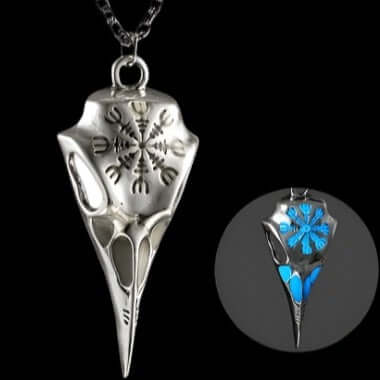
Balancing both aspects remains essential for mental resilience today, explaining why thousands of modern individuals choose Huginn and Muninn as symbols for tattoos, jewelry, and artistic expression.
8. The Enduring Legacy of Odin's Ravens
Exploring the lore of Huginn and Muninn uncovers a brilliant window into the spiritual and philosophical mind of the ancient North. Far from mere decorative birds, these two ravens embody the eternal human quest for knowledge, self-awareness, and mental preservation in the face of inevitable change.
As long as humans seek wisdom, scan the horizon for truth, and honor the deep memories of the past, the black wings of Huginn and Muninn will continue to soar across our collective imagination, echoing proudly alongside the great tales of valhalla.