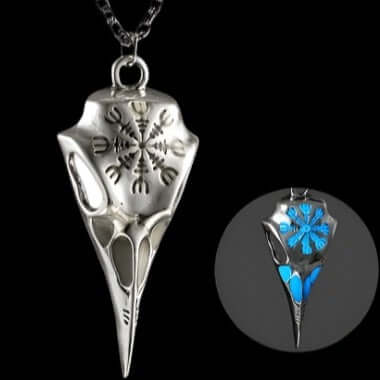
Traced on weathered parchment or etched into modern leatherwork, the eightfold radial stave catches the eye with an immediate, magnetic sense of ancient mystery. Known around the globe as "The Wayfinder," the Vegvisir Symbol has become one of the most widely recognized icons in modern Norse-inspired culture, gracing personal amulets, home decor, and thousands of tattoos worldwide.
Yet, online discussions regarding this iconic emblem are often polarizing. Critics frequently dismiss it as a 19th-century "Christian invention" entirely foreign to Scandinavian history.
Conversely, popular media frequently misattributes it directly to the shield-bosses of 9th-century sea-raiders. Both of these extreme positions oversimplify a fascinating, multi-layered story.
To understand the true history of the Vegvisir Symbol, one must explore early modern Icelandic magic—a unique intellectual tradition where ancient Norse mythology, runic lore, Celtic folklore, and European esoteric traditions merged over centuries of isolation.
In this comprehensive analysis, we will examine the primary 19th-century manuscripts containing the symbol, evaluate the archaeological record, dissect the historical reality of religious blending from the Viking Age onward, challenge common academic counterarguments, and discover why this ancient stave retains such a powerful hold on modern imagination.
1. What Is the Vegvisir Symbol? Etymology and Meaning
The word Vegvísir is a compound noun derived directly from two Old Norse and Modern Icelandic words:
- Vegur: Meaning "way," "road," or "path."
- Vísir: Meaning "pointer," "guide," or "shower."
Together, Vegvísir translates literally to "That Which Shows the Way" or simply "The Wayfinder."
+-------------------------------------------------------------------------+
|                   THE ETYMOLOGY OF VEGVÍSIR                             |
|                                                                         |
|  [ Vegur ]   ---> Old Norse for "Way", "Path", or "Road"                |
|  [ Vísir ]   ---> Old Norse for "Pointer", "Guide", or "Indicator"      |
|                                                                         |
|  Literal Translation: "That Which Shows the Way" / "The Wayfinder"     |
+-------------------------------------------------------------------------+
In late medieval and early modern Icelandic folk magic, staves like the Vegvisir were categorized as galdrastafir (magical staves). Unlike the Ægishjálmur (Helm of Awe)—whose eight radial spokes feature identical trident-like arms—each of the eight arms of the Vegvisir Symbol features a distinct arrangement of lines, circles, and crossbars.

Vegvisir Symbol
Rather than acting as a magnetic navigational compass in the modern technical sense, the Vegvisir functioned as a visual protective spell designed to prevent a traveler from becoming lost during severe weather or navigating unfamiliar terrain.
2. The Primary Manuscripts: What Do the Surviving Sources Actually Say?
To assess the historical origins of the Vegvisir Symbol, we must examine the physical books where it first appears in the written record. Currently, there are three known 19th-century Icelandic magical manuscripts (galdrakver) that preserve the symbol:
                            THE THREE VEGVÍSIR MANUSCRIPTS
                                          |
    +-------------------------------------+-------------------------------------+
    |                                     |                                     |
Huld Manuscript (1860)               Lbs 2917 a 4to (1868–69)              Lbs 4627 8vo (19th C.)
* Compiled by Geir Vigfússon         * Penned by Olgeir Geirsson          * Anonymous compiler
* Rich in Norse mythology & runes    * Features Vegvísir & Ægishjálmur    * Contains Christian invocation
1. The Huld Manuscript (ÍB 383 4to – 1860)
Compiled in Akureyri by Geir Vigfússon, the Huld Manuscript is widely praised for its exceptional calligraphy and comprehensive preservation of Icelandic folk magic.
The manuscript opens with 329 runic futharks and magical alphabets, demonstrating a deep continuity with older Scandinavian runic traditions. Page 60 of the manuscript presents two distinct versions of the Vegvisir. The accompanying caption provides the spell's core purpose:
"Bera muntu þennan staf með þér, og villist þú ekki í hríðum né vondu veðri, þó ókunnugur séir."
(Carry this sign with you and you won't get lost in storms or bad weather, even though in unfamiliar surroundings.)
2. Galdrakver (Lbs 2917 a 4to – 1868–1869)
Penned by Olgeir Geirsson, this manuscript serves as an invaluable resource containing dozens of distinct stave designs. Remarkably, it is the only surviving manuscript that preserves depictions of both the Vegvisir Symbol and the Ægishjálmur together. Its accompanying text mirrors the protective traveler's charm found in the Huld manuscript.

3. Galdrakver (Lbs 4627 8vo – 19th Century)
This anonymous booklet is frequently cited by critics who argue that the Vegvisir is exclusively a Christian symbol. In this version, the text incorporates a explicit Christian blessing alongside the stave:
"To avoid getting lost: keep this sign under your left arm, its name is Vegvísir and it will serve you if you believe in it, if you believe in God in the name of Jesus... May God give me luck and blessing in the name of Jesus."
To help visualize how these historical sources differ in content and religious tone, let us examine a comparison table of the primary surviving Vegvisir manuscripts.
| Manuscript Name | Estimated Date | Compiler / Scribe | Primary Contents & Religious Tone | Unique Feature |
| Huld Manuscript (ÍB 383 4to) | 1860 | Geir Vigfússon | Rich in Old Norse mythology, runic Futharks, and pagan god mentions | Contains two distinct visual variants of the Vegvisir |
| Galdrakver (Lbs 2917 a 4to) | 1868–1869 | Olgeir Geirsson | Collection of practical staves, folklore spells, and protective charms | Preserves both Vegvisir and Ægishjálmur in one text |
| Galdrakver (Lbs 4627 8vo) | 19th Century | Anonymous | Folk magic featuring syncretic Christian invocations | Attaches an explicit prayer in the name of Jesus to the stave |
3. Challenging the "Strictly Christian" Dismissal
In contemporary online spaces, it has become fashionable to dismiss the Vegvisir Symbol entirely as a late "Christian grimoire creation" with zero connection to Scandinavian heritage. However, this argument ignores the nuanced reality of Icelandic history.
+-------------------------------------------------------------------------+
|                  THE HISTORICAL CONTINUITY OF NORSE MATERIAL            |
|                                                                         |
|  * The Huld Manuscript contains 329 runic Futharks & cipher alphabets.   |
|  * Manuscripts feature staves like Þórshamar ("Thor's Hammer").        |
|  * Older literature preserves Ægishjálmur ("Helm of Awe") explicitly.  |
|                                                                         |
|  Conclusion: Icelandic scribes preserved genuine Norse material          |
|  alongside later medieval European magical ideas.                       |
+-------------------------------------------------------------------------+
The Presence of Genuine Norse Content
While the youngest manuscript (Lbs 4627 8vo) includes a Christian prayer, the oldest and most comprehensive manuscript (Huld) is deeply rooted in authentic Norse lore. It includes references to Aesir gods, runic ciphers (villuletur), and bindrunes.
Furthermore, these manuscripts preserve staves like Þórshamar ("Thor's Hammer"), explicitly named after the Norse god of thunder. Describing these compilations as purely foreign or Christian ignores the genuine Scandinavian content preserved within them.
Religious Blending: A Tradition Dating to the Viking Age
The presence of Christian phrasing alongside older magical symbols does not automatically prove a non-Norse origin. Religious syncretism—the blending of Christian and pagan practices—was not a late invention; it began during the Viking Age itself.
- Dual Oaths in Sagas: In Landnámabók (The Book of Settlements), Helgi the Lean, a 9th-century Norse founder of Iceland, famously summarized his faith: "On land I pray to Christ, but on the stormy sea I pray to Thor."
- Runic Oaths: In Njáls Saga, characters swear formal legal oaths invoking both Christ and ancient runic traditions: "I swear by the name of Christ and by the ancient, sacred runes that my word shall never be broken."
- Archaeological Evidence: Excavations across Viking Age Scandinavia frequently yield molds designed to cast both Christian crosses and Thor's Hammer (Mjolnir) pendants side by side, proving that traders and warriors navigated dual faith systems for generations.
Therefore, when a 19th-century scribe attached a Christian blessing to the Vegvisir, he was following a thousand-year-old Icelandic tradition of reframing older protective charms within contemporary religious frameworks.
- See more: Hnefatafl
4. Academic Counterarguments: Solomonic Magic and the Absence of Archaeology
To maintain a rigorous historical analysis, we must evaluate the primary arguments raised by academic critics regarding the Vegvisir Symbol.

Vegvisir Symbol
1. The Solomonic Comparison
Critics often argue that the radial layout of the Vegvisir resembles European "Solomonic" magical sigils popularized during the Renaissance.
While visual similarities exist among medieval European magical traditions, no direct equivalent or exact match for the Vegvisir symbol has ever been found in any continental Solomonic grimoire.
Furthermore, circular, eight-spoked radial designs existed in Scandinavian metalwork and rock art centuries before continental grimoires reached the far North. Visual similarity alone does not establish direct descent without manuscript proof.
+-------------------------------------------------------------+
|               SYNTHESIS OF ICELANDIC FOLK MAGIC             |
|                                                             |
|   Norse Runic Lore  +  Gaelic Storytelling  +  European Sigils |
|   * Stave Design       * Oral Preservation    * Grimoire Format |
|   * Aesir Mentions     * Island Isolation     * Layered Spells  |
+-------------------------------------------------------------+
2. The Archaeological Silence
The most compelling argument against a Viking Age origin for the Vegvisir is archaeological: there are currently zero surviving physical artifacts featuring the Vegvisir symbol dating prior to the 19th century.
While this fact proves that we cannot definitively date the symbol to the 9th or 10th century, absence of evidence is not necessarily absolute proof of absence.
Why Organic Artifacts Rarely Survive
As Icelandic scholar Ólafur Davíðsson documented over a century ago, historical magic staves were rarely carved into stone monuments. Instead, they were written on perishable materials:
- Scraped into birch bark, wooden plates, or ship timbers
- Drawn with saliva or blood on skin or fingernails
- Written on fragile calfskin parchment or paper notebooks
In the cold, humid climate of Northern Europe, organic items decay rapidly. Furthermore, during the 16th and 17th centuries, Denmark and Iceland experienced severe witch prosecutions. While Iceland's trials overwhelmingly targeted men (with approximately 22 confirmed executions), confiscated magical booklets (galdrakver) were systematically gathered and burned by authorities.
Much like the discovery of the Dead Sea Scrolls in 1947 dramatically pushed back our physical manuscript evidence for biblical texts by a thousand years, surviving manuscript timelines remain limited by what manages to escape destruction.
5. The Cultural Soil of Iceland: Preserving the Heritage of the North
Understanding why the Vegvisir Symbol emerged in Iceland requires recognizing the unique cultural position of the island nation.
Settled in the late 9th century by Norse seafarers and Gaelic arrivals, Iceland remained remarkably isolated for centuries. While mainland Scandinavian languages (Swedish, Danish, and Norwegian) underwent significant grammatical simplification, the Icelandic language remained virtually unchanged, preserving Old Norse vocabulary down to the modern day.
                               ICELANDIC HERITAGE
                                       |
    +----------------------------------+----------------------------------+
    |                                  |                                  |
Linguistic Preservation             Literary Preservation              Cultural Isolation
* Moderns read 13th-C. sagas        * Eddas & Skaldic Poetry           * Stable island population
* Preserves Old Norse grammar       * Preserves pagan mythos           * Retains traditional folklore
When the Althing (Iceland's parliament) formally accepted Christianity around the year 1000 CE, it did so with a pragmatic compromise that allowed certain traditional practices to continue in private.
This relative tolerance permitted Icelanders to preserve a massive share of medieval Scandinavian literature, mythology, and magical lore that was entirely lost across continental Europe.
6. Real-Life Connections: The Modern Wayfinder in Global Culture
You might wonder why the historical debate surrounding the Vegvisir Symbol resonates so deeply with audiences in the United States and across the world today.
A Symbol of Personal Guidance and Resilience
In modern culture, the Vegvisir has transcended its technical historical origins to become a universal symbol of personal direction, resilience, and spiritual grounding. For millions of people navigating life transitions, carrying or wearing the Wayfinder serves as a meaningful reminder to stay true to one's path through stormy weather.
Heritage Travel and Genealogical Connection
Furthermore, as ancestral DNA testing allows millions of Americans to trace their heritage back to Scandinavian and British Isles roots, interest in genuine historical symbols has surged. Exploring the complex history of Icelandic galdrastafir offers a hands-on bridge to understanding the real-life struggles, beliefs, and artistic traditions of ancient northern ancestors.
7. The Future of Icelandic Stave Research
As we look toward the future, our understanding of the Vegvisir Symbol and Icelandic magic continues to advance through rigorous academic research.
Scholars at the Institute of Icelandic Studies and independent runologists regularly digitize, transcribe, and analyze previously unexamined parchment fragments stored in Scandinavian archives. High-resolution multispectral imaging allows researchers to read faded ink layers on damaged manuscripts, ensuring that our picture of early modern folk magic grows clearer with every passing year.
The Enduring Power of the Wayfinder
Exploring the history of the Vegvisir Symbol reveals a story far richer than simple internet myths or rigid academic dismissals. Born from the unique cultural soil of Iceland, the Vegvisir represents a fascinating synthesis where ancient Scandinavian memory, runic art, and protective folk charms met the evolving beliefs of a changing world.
Whether viewed as a 19th-century magic stave, a testament to Icelandic literary preservation, or a modern symbol of personal guidance, the Wayfinder continues to fulfill its historic purpose. The ancient longships may have anchored for the final time, but the Vegvisir still points the way forward, echoing proudly alongside the great tales of valhalla.