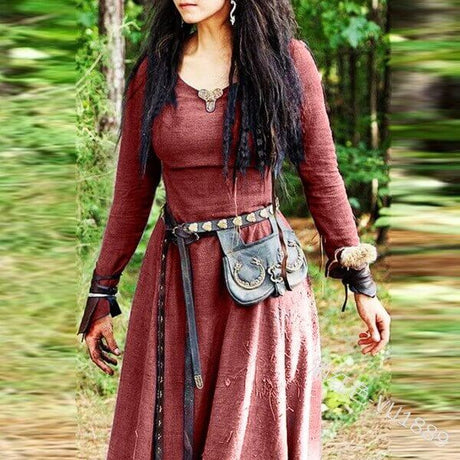
Imagine sitting near a crackling hearth in a dimly lit longhouse as a cold Scandinavian wind howls outside. The air smells of pine, burning tallow, and dried herbs. A woman clad in a cloak lined with white cat fur sits elevated on a wooden platform. She holds a bronze-tipped staff in her hand, swaying rhythmically as chanting voices fill the room. She enters a deep trance, reaching beyond the physical realm to speak with spirits and uncover what the future holds.
This vivid scene was a lived reality for Viking communities. The practice she engaged in was Seidr, the intuitive shamanic magic of the Norse world. Paired with the sharp, carved power of runic staves, these traditions formed the backbone of ancient Scandinavian spirituality.

Seidr and Runes
Together, Seidr and Runes offered early Germanic societies a way to understand the complex threads of fate woven by the Norns. Today, modern seekers across the United States look back at these ancient traditions to find deeper personal meaning, spiritual clarity, and connection with ancestral wisdom.
Let us journey into the heart of Norse mysticism to discover how Seidr and Runes worked together to reveal fate, influence destiny, and unlock hidden realms.
Understanding Norse Magic: Two Complementary Paths
To understand ancient Scandinavian spirituality, you must first recognize that the Norse people did not view magic as a single uniform practice. They divided mystical work into distinct categories with unique methods, tools, and social expectations.
While several forms of sorcery existed, the two most powerful pillars were Seidr and Runes. Understanding how these two practices interacted reveals how the Norse people balanced intuitive cosmic insight with structured cosmic law.
The Contrast Between Fluidity and Carved Precision
Seidr represents the fluid, ecstatic, and receptive aspect of Norse mysticism. Practitioners used trance states, chanting, and spirit travel to alter consciousness and weave fate directly. It was organic, personal, and heavily tied to spiritual possession and prophecy.
In contrast, runic magic represents structured, active, and symbolic authority. Runes were not merely an alphabet used for writing messages on stone. Each runic character held a divine principle, a cosmic force that could be carved into wood, bone, or iron to alter reality directly.
| Dimension | Seidr Practice | Runic Magic (Galdr) |
| Primary Nature | Ecstatic, intuitive, shamanic | Intellectual, symbolic, active |
| Core Technique | Trance states, chanting (Varðlokur), staff work | Carving, painting with blood/ochre, incantations |
| Associated Deity | Freyja (introduced it to Aesir), Odin | Odin (sacrificed himself to learn the staves) |
| Social Perception | Highly respected yet feared; taboo for men (Ergi) | Widely practiced by warriors, chieftains, and poets |
| Primary Purpose | Prophecy, spirit travel, weaving personal fate | Protection, victory, healing, binding promises |
What is Seidr? The Ecstatic Magic of the Völva
Seidr was an ancient form of shamanic magic deeply rooted in Scandinavian tradition. The word itself connects to Old Norse terms meaning to boil, weave, or bind. This linguistic connection offers a massive clue about how practitioners viewed their work. They saw fate as a giant tapestry composed of woven threads, and Seidr was the tool used to alter those strands.

What is Seidr?
The Role of the Völva
The primary practitioners of Seidr were women known as völvas (singular: völva), which translates literally to "wand-bearer" or "staff-carrier." A völva traveled from settlement to settlement, offering her prophetic services to community leaders, farmers, and chieftains.
When a völva arrived at a farmstead, the family held a elaborate ceremony. The practitioner sat on a high platform (seiðhjallr) elevated above the audience. Guided by a chorus singing special incantations called Varðlokur (ward-locks), she slipped into a deep trance.
While in this altered state, the völva's spirit (hugr) left her physical body. Her consciousness traveled through the Nine Realms of Yggdrasil to consult with ancestors, land spirits (landvættir), and deities. Upon returning to her waking body, she revealed visions of upcoming harvests, weather patterns, military fortunes, or personal destinies.
Freyja and Odin: Divine Masters of Seidr
In mythology, Seidr originated with the Vanir, the elder tribe of fertility deities. The goddess Freyja was the supreme master of Seidr. When the Aesir and Vanir gods concluded their legendary war and exchanged hostages, Freyja introduced Seidr to Asgard.
Odin, the Allfather, became obsessed with learning this feminine art. He recognized that Seidr offered direct access to cosmic secrets that physical strength could never unlock. However, male practice of Seidr carried significant social taboos in Viking society, often labeled as ergi (unmanliness). Odin disregarded these rigid social norms, demonstrating his relentless drive to acquire ultimate wisdom at any cost.
The Power of Runes: Symbols of Cosmic Law
If Seidr is the art of reading and weaving the spiritual winds, the runes are the fundamental building blocks of the universe itself. To the Norse mind, runes were not invented by human scholars. They were eternal cosmic truths woven into the fabric of reality.
The Mythic Origin: Odin’s Ultimate Sacrifice
The primary account of how humanity acquired runic wisdom appears in the Eddic poem Hávamál (Stanzas 138-139). Odin sought to comprehend the deepest mysteries of life and death, leading him to perform a terrifying self-sacrifice.
Odin hung himself from the windswept branches of Yggdrasil for nine full days and nights. He pierced his own side with a spear, offering himself to himself. He endured hunger, thirst, and agony without aid from the other gods.
On the ninth night, as he peered into the dark waters of Niflheim beneath the tree roots, the secrets of the runes revealed themselves to him. Screaming with agony and ecstasy, Odin reached down, seized the burning symbols, and fell back from the tree transformed.
"I know that I hung on a windy tree
nine whole nights,
wounded with a spear, dedicated to Odin,
myself to myself...
I peered down, I took up the runes,
screaming I took them, and fell back from there."
— Hávamál, Stanzas 138-139
The Structure of the Elder Futhark
The oldest complete runic system is the Elder Futhark, consisting of 24 distinct staves. The system takes its name from the sound of its first six characters: F, U, Th, A, R, K.
Scholars organize the 24 runes into three groups of eight, known as Aetts (families). Each Aett is overseen by specific deities and governs distinct areas of human experience and spiritual evolution.
| Aett Name | Associated Deities | Primary Themes and Concepts | Key Example Runes |
| Freyr's Aett | Freyr and Freyja | Wealth, vitality, physical creation, foundational needs | Fehu (Wealth), Uruz (Strength), Thurisaz (Thorn/Defense) |
| Heimdallr's Aett | Heimdallr and Skadi | Transformation, chaos, trial, spiritual growth, order | Hagalaz (Hail/Disruption), Isa (Ice/Stasis), Jera (Harvest) |
| Tiwaz Aett | Tyr and Ziu | Justice, sovereignty, human spirit, cosmic destiny | Tiwaz (Justice/Warrior), Berkano (Birth/Rebirth), Dagaz (Daybreak) |
The Mechanics of Fate: Örlög and Wyrd
To understand how Seidr and Runes worked together, you must grasp the Norse concept of fate. Western culture often views fate as a rigid, unchangeable script where every detail is predetermined. The Norse view was far more dynamic and interactive.

The Mechanics of Fate: Örlög and Wyrd
The Web of Wyrd and the Norns
At the base of Yggdrasil sits the Well of Urd (Urdarbrunnr). There reside the three Norns:
-
Urd: What has come to pass (The Past / Ancestral Memory)
-
Verdandi: What is currently becoming (The Present / Active Choice)
-
Skuld: What ought to happen (The Potential Future / Obligation)
The Norns continually spin, weave, and carve threads of fate into the Web of Wyrd. Every action, word, and oath taken by a mortal or god drops a new thread into the well, shaping the tapestry.
Your personal ancestral destiny is your Örlög (literally "primal law"). Your Örlög represents the initial hand of cards you are dealt at birth, including your lineage, physical gifts, and cultural starting point. However, your choices in the present (Verdandi) actively influence how your future (Skuld) unfolds.
This is where Seidr and Runes came into play. A völva using Seidr peered into the Web of Wyrd to observe the existing pattern. Meanwhile, a rune master carved bindrunes to introduce new intent into the web, shifting the momentum of fate in their favor.
Archaeological Discoveries Supporting the Texts
For centuries, modern critics dismissed saga accounts of völvas, staffs, and runic charms as romantic medieval folklore. However, dramatic archaeological finds across Scandinavia and Britain over the past century have validated these historical texts.
The Grave of the Fyrkat Völva
In 1977, archaeologists excavating a Viking Age ring fortress at Fyrkat in Denmark discovered an extraordinary woman's grave dating back to around 980 CE. She was buried in a fine carriage body, wearing lavish clothing dyed with expensive import colors.
Inside her grave, researchers uncovered definitive evidence of a Seidr practitioner:
-
An iron staff topped with bronze fittings, identical to saga descriptions of a völva's wand.
-
Small pouches containing seeds of henbane, a hallucinogenic plant known to induce altered states of consciousness when burned or used in unguents.
-
Animal bones, including owl pellets and toad bones, used in ritual divinations.
-
Silver amulets shaped like chairs, symbolizing the seiðhjallr platform.
Runestone Distribution Data
Archaeological surveys have cataloged thousands of runestones across northern Europe, demonstrating that runic literacy was closely tied to memorializing family, claiming property, and invoking divine protection.
| Region | Cataloged Runestones | Primary Inscription Purpose | Historical Era |
| Sweden (Uppland & Södermanland) | 2,500+ | Memorials, family inheritance, christianization markers | 9th - 11th Century |
| Denmark & Scania | 900+ | Royal monuments, territorial borders, war honors | 8th - 10th Century |
| Norway | 450+ | Burial markers, spell formulas, trade signatures | 5th - 11th Century |
| British Isles & Iceland | 200+ | Cultural integration, personal names, devotional charms | 9th - 12th Century |
Counterarguments and Skeptical Perspectives
When evaluating historical practices like Seidr and Runes, we must maintain a balanced perspective and acknowledge the limitations of our sources.
The Problem of Post-Christian Scriptoriums
The majority of written accounts describing Seidr and Runes were composed by Christian scholars, such as Snorri Sturluson, 200 to 300 years after the Viking Age ended.
Skeptical historians point out that medieval authors lived in a Christian world that viewed pagan magic through specific ideological lenses. Some scholars argue that authors like Sturluson may have romanticized or demonized pagan practices to make them fit classical literary models or biblical moral codes.
- See more: Bifröst and Heimdallr
Modern Re-Invention vs. Historical Fact
Another common debate involves modern runic divination systems. Many contemporary popular books claim that ancient Vikings drew single runes from velvet pouches for daily personal advice, similar to tarot card readings.
While the Norse certainly used runes for magical protection, cursing, and victory charms, direct historical evidence for randomized "rune casting" as popular today is limited in early records. Tacitus, a Roman historian writing in 98 CE, noted that Germanic tribes cast stripped twigs carved with signs onto white cloths for omens, but whether these were the 24 Elder Futhark runes remains open to scholarly debate.
Modern Resurgence in the United States and Beyond
Despite these historical debates, interest in Seidr and Runes is undergoing a massive revival across North America. Thousands of individuals look to these ancient practices not as historical reenactments, but as living traditions.
Modern practitioners adapt these ancient tools to address contemporary mental health challenges, personal growth goals, and environmental awareness:
-
Spiritual Grounding: Working with runes offers a physical, meditative anchor in a world dominated by digital screens and rapid change.
-
Ancestral Connection: Exploring Nordic folklore helps individuals reconnect with northern European heritage and cultural roots.
-
Empowerment Through Mindful Action: The Norse view of fate emphasizes personal responsibility. You are not a helpless victim of fate; your present actions directly weave your future.
As modern life grows increasingly fast-paced and disconnected from nature, these ancient methods of reflection provide a timeless bridge back to personal agency and cosmic balance.
Practical Steps for Exploring Runic Wisdom Today
If you feel called to explore the world of runic symbols and Norse philosophy, you do not need to sit atop a wooden platform in a longhouse to begin. You can approach this study with curiosity, respect, and intellectual rigor.
-
Study Historical Texts First: Start by reading translation sources like Carolyne Larrington's translation of The Poetic Edda or Anthony Faulkes' translation of Snorri Sturluson's Prose Edda.
-
Learn the Characters Intentionally: Focus on one rune per day. Draw the shape, study its historical poem stanza, and reflect on its symbolic meaning in your daily journal.
-
Connect with Nature: The Norse world was intimately tied to seasons, trees, weather, and animal behavior. Spend time outdoors observing natural cycles to understand the organic roots of these symbols.
-
Maintain Ethical Boundaries: Approach these ancestral traditions with respect for historical context, avoiding commercialized shortcuts or misrepresentations.
Conclusion
The magic of Seidr and Runes offers a captivating glimpse into how the ancient Scandinavian people navigated their world. Through the intuitive, ecstatic visions of the völva and the sharp, eternal truths carved into runic staves, they found meaning in a harsh and unpredictable environment.
These twin practices reminded mortals that while fate weaves a powerful pattern, human courage and conscious action always matter. The wisdom of the Norns continues to inspire modern seekers, proving that the ancient symbols hold endless relevance as we write our own tales of valhalla.