Across the mist-shrouded history of the North, no creature carries as much weight, wisdom, and dark omen as The Raven. While the wolf represents raw, untamable power and the dragon embodies the depths of the earth, the raven is the bird of the mind. It is the bridge between the physical world and the spiritual heights of Asgard.
In this comprehensive guide, we explore why The Raven is the most enduring symbol of the Viking Age, its deep connection to the All-Father Odin, and why its shadow continues to inspire warriors and creators in 2026.
The Eyes of the All-Father: Huginn and Muninn
To speak of The Raven in Norse mythology is to speak of Odin. The King of the Aesir is often called Hrafnagud—the "Raven God." He is rarely seen without his two constant companions: Huginn (Thought) and Muninn (Memory).
Every dawn, Odin sends his two ravens to fly across the Nine Realms. They soar over Midgard, witness the secret dealings of men, and watch the gathering storms of giants. At breakfast, they return to Valhalla, perching on Odin’s shoulders to whisper into his ears everything they have seen and heard.

The Raven
For the Vikings, the raven wasn't just a bird; it was a manifestation of Odin’s omnipresence. It represented the idea that a true leader must possess more than just strength—they must possess information, memory, and foresight.
The Raven as a Symbol of the Battlefield
Beyond the halls of wisdom, The Raven held a much grimmer role on the blood-soaked fields of Midgard. Ravens are carrion birds, and where there was a battle, the ravens were sure to follow.
This led to the raven becoming a "chooser of the slain." Viking poets, or skalds, often referred to war as "feeding the ravens." To see a raven circling over a battlefield was not necessarily a bad omen; rather, it was a sign that Odin was present, ready to collect the bravest souls to join his army of the Einherjar in Valhalla.
The sighting of a raven before a voyage or a raid was considered a blessing. It meant the All-Father’s eyes were on the warriors, guiding their path toward either victory or a glorious seat at his table.
- See more: The Fenrir Wolf
The Raven Banner: The Standard of Conquerors
The historical impact of The Raven is most evident in the famous Raven Banner (Hrafnsmerki). This triangular flag, depicting a soaring black raven, was carried by some of the most legendary Viking leaders in history, including:
- Ragnar Lothbrok and his sons.
- Harald Hardrada, the last great Viking king.
- The Great Heathen Army during their invasion of England.
Legend held that if the raven on the banner fluttered its wings, victory was certain. If it hung limp, the battle was lost. This psychological warfare proved incredibly effective, as the sight of the raven banner descending upon a coast struck terror into the hearts of those who stood in the Vikings' path.
The Raven in 2026: Modern Symbolism and Meaning
In the modern era, The Raven has evolved into a symbol of multi-dimensional depth. It is no longer just a bird of war, but a totem for those who value:
- Perspective: The ability to see the "big picture" from a higher vantage point.
- Intellect: Recognizing that the sharpest blade is useless without the sharpest mind.
- Transformation: As birds that thrive in the threshold between life and death, ravens represent the courage to change and evolve.
Whether it is in literature (like the haunting verses of Edgar Allan Poe) or in the gritty realism of Viking-inspired media, the raven remains the ultimate icon of the "Thinking Warrior."
The Raven Aesthetic: Why it Defines Viking Art
Viking art styles, such as the Borre or Jellinge styles, frequently feature the raven. Its sleek silhouette, sharp beak, and obsidian feathers lend themselves perfectly to the intricate knotwork found on shields and weapons.
For collectors, The Raven aesthetic represents a balance. It isn't as loud as a roaring wolf, but it is far more observant. A raven-themed weapon or shield suggests a user who strikes with precision, waits for the right moment, and remembers every slight.
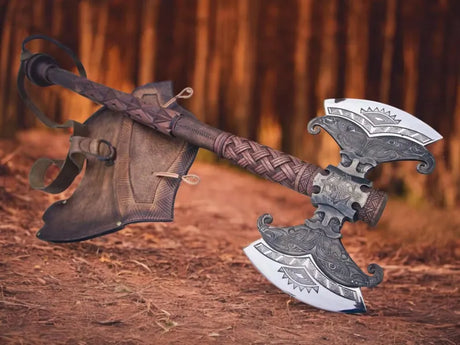
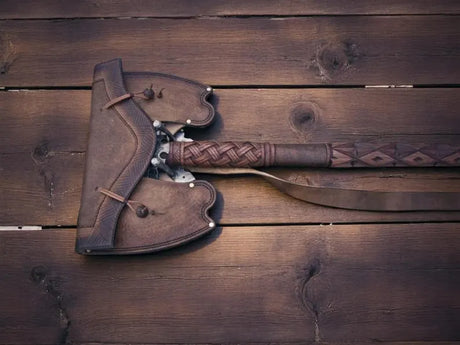
The Ultimate Tribute: The Raven Shadow Shield & Axe Set
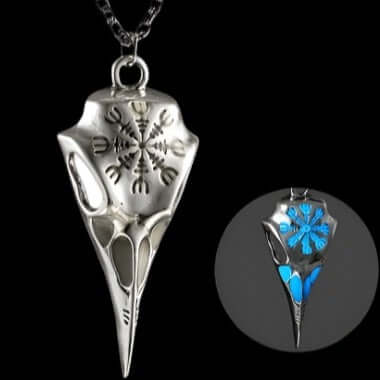
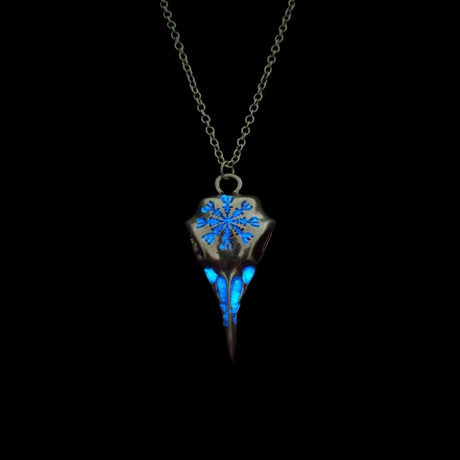
While many carry a raven pendant, the true spirit of the All-Father is best captured in the tools of his trade: the shield and the axe.
In Viking combat, the shield was not just for defense—it was a canvas for psychological warfare. A shield bearing the mark of The Raven signaled to the enemy that Odin was watching. Paired with a masterfully forged axe, this set represents the duality of the Viking spirit: the wisdom to plan the attack and the power to execute it.
The "Shadow" variant of these designs often uses darkened steel and deep-etched patterns to mimic the iridescent black of a raven’s wing, creating a piece that is both stealthy and striking.

The Raven Shadow Shield & Axe Set
Conclusion
The Raven is the heartbeat of the North. It reminds us that while our muscles may fail and our kingdoms may fall, our Thought and our Memory are what make us immortal. To walk with the raven is to walk with the wisdom of Odin, acknowledging that every end is simply a new beginning in the eyes of the All-Father.
Are you ready to claim your place in the halls of wisdom? Do not let the shadow of the raven pass you by. Arm yourself with the tools of the ancient messengers.
Heed the call of Valhalla. Master the battlefield of the mind and shop the Raven Shadow Shield & Axe Set at Tales of Valhalla today!