In the vast lexicon of ancient symbols, few images are as hauntingly beautiful or as philosophically dense as the Ouroboros. Depicting a serpent or dragon consuming its own tail to form a perfect circle, this emblem has slithered through the collective consciousness of humanity for millennia. It is a visual paradox: a creature that is simultaneously destroying itself and creating itself, representing the infinite cycle of life, death, and rebirth.
For many seekers in the United States, the Ouroboros resonates because it speaks to the cyclical nature of our own lives. We see it in the changing of the seasons, the rotation of the planets, and the personal transformations we undergo as we shed our old selves to make room for the new. To understand the Ouroboros is to understand the rhythmic pulse of the universe itself.
Ancient Origins: A Symbol Without a Beginning
The term Ouroboros derives from the Greek words oura (tail) and boros (eating). While the name is Greek, the concept is far older. The earliest known depiction of the Ouroboros appears in the Enigmatic Book of the Netherworld, an ancient Egyptian funerary text found in the tomb of Tutankhamun.
The Serpent Across Cultures
From Egypt, the symbol traveled to the Greek alchemists, who viewed the Ouroboros as a representation of the "All is One." It signified the unity of matter and spirit, suggesting that nothing in the universe is ever truly lost—it only changes form.
I remember a conversation with a geologist in Colorado who kept a small Ouroboros carving on his desk. He remarked that the symbol is the perfect mascot for the rock cycle. "The earth consumes its own crust through subduction only to spit it back out as volcanic peaks," he said. "The planet is the ultimate Ouroboros."

The Ouroboros: Decoding the Infinite Symbol of Eternal Return
The Norse Connection: Jörmungandr and the World Circle
While the Ouroboros is a universal archetype, it takes on a particularly fierce and grand scale in Norse mythology. Here, it is embodied by Jörmungandr, the Midgard Serpent.
Bound by the Tail
According to the legends, Odin took the three children of Loki and cast Jörmungandr into the great ocean that encircles Midgard. The serpent grew so large that it eventually spanned the entire world, grasping its own tail in its mouth. This Norse version of the Ouroboros serves as the literal boundary of the human realm.
| Aspect of the Symbol | Mythic Interpretation | Psychological Meaning |
| The Circular Shape | The horizon and world boundary | Wholeness and self-containment |
| Eating the Tail | Maintaining the world's order | Self-reflection and inner growth |
| The Serpent/Dragon | Primal, chaotic power | The subconscious and hidden strength |
| The Eternal Loop | The inevitability of Ragnarok | The acceptance of change |
In the Norse tradition, the moment Jörmungandr lets go of its tail, the end of the world—Ragnarok—begins. Thus, the Ouroboros is the symbol of the tension that holds the universe together. It represents the balance between order and chaos.
Alchemical and Psychological Depth
In the Middle Ages, alchemists adopted the Ouroboros as a symbol of the mercurial process. They saw it as a representation of a closed laboratory system where heating, evaporation, and condensation occurred in a perpetual loop.
Jung and the Infinite Self
In the 20th century, the famous psychologist Carl Jung viewed the Ouroboros as a fundamental archetype of the human psyche. He argued that it represents the "pre-conscious" state of infancy and the ultimate goal of "individuation"—where a person integrates all parts of themselves into a harmonious whole.
When you wear or meditate on the Ouroboros, you aren't just looking at a snake; you are looking at the map of the soul. It is a reminder that your end is often your beginning, and that every "death" of an old habit is the "birth" of a new wisdom.
- See more: The Raven
The Ouroboros in Modern American Culture
Today, the Ouroboros remains a powerhouse of modern iconography. We see it in:
- Environmental Movements: Representing the sustainability of the "circular economy" and the recycling of resources.
- Mathematics and Physics: Echoing the concept of infinity and the feedback loops found in complex systems.
- High Fashion and Jewelry: Chosen by those who want a symbol that feels both ancient and cutting-edge.
In a culture that often prizes "linear" progress—constantly moving forward without looking back—the Ouroboros offers a necessary counter-argument. It tells us that looking back is how we move forward, and that our roots are just as important as our branches.

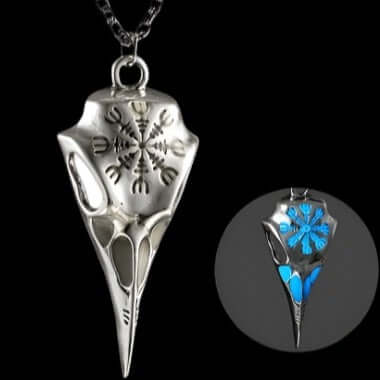
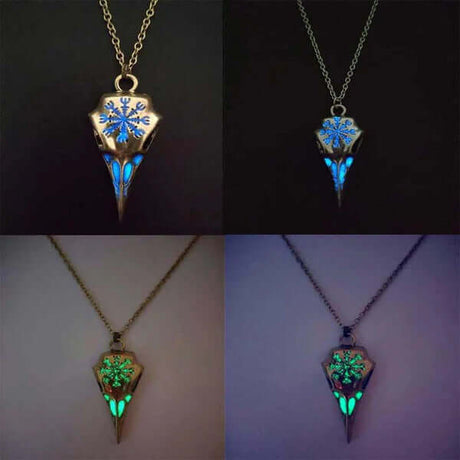
Yggdrasil and Ouroboros Necklace
Conclusion
The Ouroboros is a silent teacher. it tells us that the universe is a masterpiece of recycling, where every atom has been something else before and will be something else again. It is the ultimate symbol of resilience. No matter how many times the circle is challenged, it remains unbroken.
To truly honor this eternal rhythm, one must recognize the connection between the serpent of the depths and the tree of the heights. The Yggdrasil and Ouroboros Necklace invites you to explore new horizons with its intricate design symbolizing the divine World Tree, its branches reaching skyward in a timeless dance. This unique piece transports you to the mystical heart of the nine realms, where the roots of Yggdrasil hold the universe's secrets. Together, they represent the full spectrum of existence—the vertical growth of the spirit and the horizontal cycle of time—found within the greatest tales of valhalla.
"Tales of Valhalla is an expert chronicler of the Viking Age, blending scholarly research with master storytelling to revive the Old North. From the hidden depths of Norse mythology to the tactical grit of the sagas, they provide authentic, rich insights into the warriors, leaders, and legends that forged history." - Specialist in Norse mythology and Viking history