Imagine standing in a space where absolute nothingness rules supreme. There is no solid ground beneath your feet, no sky above your head, and no stars to guide your vision. For many people living in our fast-paced modern world, the idea of complete emptiness is almost impossible to visualize. We are constantly surrounded by towering skyscrapers, sprawling highway networks, and digital screens that keep our minds entirely occupied.
The ancient Norse storytellers approached the concept of ultimate beginnings with a fascinating mixture of raw elemental terror and deep spiritual reverence. They did not believe that the universe simply exploded into existence from a sterile mathematical point. Instead, they taught that everything we can see, touch, and experience across our physical world was carved directly from the living tissue of a colossal, primordial entity known as Ymir.
[Niflheim: Primordial Ice] ───> [Ginnungagap: The Void] <─── [Muspelheim: Primordial Fire]
                                       │
                                       ▼
                          [The Emergence of Ymir]
While contemporary pop culture often celebrates the heroic exploits of popular characters like Thor wielding his mighty hammer or Odin surveying the cosmos from his high throne, the actual foundations of Scandinavian mythology rest upon a much older, darker foundation. Long before the first grand halls of Asgard were built, the entire cosmic structure was defined by the presence of a single, monumental giant whose massive body contained the raw elements of creation itself.
The story of Ymir is a beautiful, brutal epic that explores how order was forcibly carved out of chaotic emptiness. As the first living being in the Norse creation narrative, Ymir represents the ultimate ancestor, the cosmic canvas, and the foundational sacrifice that allowed life to flourish.
This comprehensive exploration will dive deep into the fascinating history, hidden psychological symbols, and enduring academic legacies surrounding this ancient giant. We will discover how the dynamic interplay of extreme frost and burning fire generated the first spark of conscious life, examine the structural details of how the world was constructed from his physical remains, and find out why this ancient tale of creative destruction continues to echo powerfully in our modern imagination.
The Birth of the First Giant: Ice, Fire, and the Void
To trace the lineage of Ymir, we must look far back beyond the concept of time itself, to a period when the cosmos was divided into two diametrically opposed realms of raw environmental energy. To the extreme north lay Niflheim, a frozen wasteland dominated by biting frost, freezing mists, and toxic glacial rivers. To the extreme south lay Muspelheim, a blazing desert filled with roaring fires, glowing embers, and intense, unyielding heat.
Squeezed tightly between these two extreme environments was Ginnungagap, an immense, silent void that stretched out into the darkness. For uncounted ages, the frozen mists of the north drifted into this empty chasm, where they encountered the warm, glowing winds blowing gently from the south.

The Birth of the First Giant: Ice, Fire, and the Void
When the absolute cold of Niflheim met the burning heat of Muspelheim in the middle of that silent void, the frost began to melt. As the drops fell and quickened with life through the heat, they formed the shape of a colossal living being. This entity was Ymir, the very first giant and the ancestor of all the strange, elemental powers that would later inhabit the outer realms of the universe.
The literal etymology of the name Ymir connects back to ancient Germanic words meaning twin, double, or hermaphrodite. This linguistic root reveals a vital aspect of his biological nature. Ymir was not a conventional male or female entity.
He was a self-sustaining, primal force who contained both creative principles within his own massive form. He was a complete ecosystem unto himself, capable of generating new life without the need for a partner.
The Ecology of Creation: The Celestial Cow and the First Offspring
As the primordial giant stretched his massive limbs inside the dark void, he required a source of nourishment to sustain his rapidly expanding physical frame. The melting frost of Ginnungagap responded to this need by forming a second ancient creature, a magnificent, prehistoric cow named Audhumla.
This celestial animal provided sustenance to Ymir by producing four massive rivers of nutrient-rich milk directly from her udder, allowing the giant to grow stronger with each passing day. While Ymir drank the milk, Audhumla sustained herself by licking the salty, mineral-rich blocks of primordial ice that surrounded them in the dark chasm.
[Primordial Ice Blocks] ───> [Audhumla Licks the Ice] ───> [Buri is Revealed]
                                       │
                                       ▼
                             [Rivers of Divine Milk]
                                       │
                                       ▼
                             [Nourishment for Ymir]
As Ymir slept, nourished by the milk of Audhumla, his massive body began to generate the very first generation of giants. The warmth of the southern winds caused him to sweat, and from the moisture beneath his left armpit, a fully formed male and female giant emerged into the world. At the exact same time, his feet rubbed together in his sleep, conceiving a strange, six-headed son who would become the ancestor of the formidable frost giants.

Ymir: The Primordial Giant of Norse Mythology and the Sacred Origins of the Cosmos
Meanwhile, the continuous licking of the salty ice blocks by Audhumla began to reveal a completely different type of entity. On the first day of her licking, a man’s hair emerged from the frozen blocks. On the second day, a complete human head appeared.
By the third day, an entire being stood free from the ice. This was Buri, a handsome, powerful figure who would become the grandfather of the modern Norse gods, setting the stage for a massive geopolitical conflict over who would rule the cosmos.
The Great Cosmic Betrayal: The Slaying of Ymir
As generations passed inside the crowded void of Ginnungagap, a deep structural tension began to grow between the expanding family of giants and the newly emerged lineage of the gods. Buri’s son, Borr, married a giantess named Bestla, and together they produced three extraordinarily powerful sons: Odin, Vili, and Ve.
These three young gods looked out at the universe around them and grew increasingly dissatisfied with what they saw. Ymir had grown so massive and chaotic that his unruly presence filled the entire void, leaving absolutely no room for order, beauty, or steady development. The young gods perceived the primordial giant as an unpredictable, dangerous force of nature that had to be brought under control if the universe was ever going to progress.
[Unruly Chaos of Ymir] ───> [Odin, Vili, and Ve Rebel] ───> [The Slaying of Ymir] ───> [The Blood Deluge]
Driven by a desire for political order, Odin and his brothers launched a sudden, violent assault against Ymir. A massive battle took place in the depths of Ginnungagap, resulting in the death of the primordial giant.
The volume of blood that poured from Ymir’s fatal wounds was so immense that it created a catastrophic deluge, washing across the void and drowning almost the entire race of giants he had created. Only a single giant couple, Bergelmir and his wife, managed to escape the slaughter by climbing aboard a hollowed-out tree trunk, ensuring that the lineage of the giants would survive in the distant, icy corners of the world.
Mythological Metrics: The Anatomy of a New World
Following their decisive military victory over the forces of chaos, Odin, Vili, and Ve did not leave the massive corpse of Ymir to rot in the empty void. Instead, they used his remains as raw building materials, systematically dismantling his body to construct the physical geography of our world, which they named Midgard.
Let us look closely at how the different parts of Ymir’s physical form were reassigned by the gods to create the varied landscapes, weather systems, and celestial features that surround us today.
| Original Part of Ymir's Body | New Earthly Feature Created | Ecological and Cosmic Function |
| Flesh | The Soil and Dry Land | Provides the solid foundation for human habitats |
| Blood and Sweat | The Oceans, Seas, and Lakes | Fills the great basins and creates the water cycle |
| Bones | The Mountains and Ranges | Forms the rigid, structural spine of the world |
| Teeth and Broken Bone Splinters | The Rocks, Stones, and Pebbles | Scatters across the landscape as natural features |
| Skull | The Dome of the Sky | Stretches overhead to contain the atmosphere |
| Brains | The Heavy Clouds | Drifts through the air to bring rain and storms |
| Hair | The Trees, Grass, and Foliage | Clothes the bare earth in vibrant green vegetation |
When we study this detailed structural breakdown, we see that the ancient Scandinavian peoples possessed a deeply integrated view of their environment. They did not look at a mountain range or a stormy sky as a random collection of dead matter.
To them, walking across the earth was an intimate act of treading upon the flesh of the primary ancestor. Every splash of ocean water was a drop of ancient blood, and every cloud drifting across the horizon was a piece of a giant's shattered mind, creating a deep sense of connection between humanity and the physical landscape.
Alternative Perspectives: Was the Slaying of Ymir an Act of Evil?
For many generations, traditional commentators have praised Odin and his brothers as heroic figures who brought light, civilization, and order to a dark, chaotic void. They viewed the destruction of Ymir as a necessary step in cosmic evolution, painting the giant as an unthinking monster who had to be cleared away to make room for human progress.
However, when we analyze this myth from an alternative perspective, a much more complicated moral picture begins to appear. We can easily argue that the slaying of Ymir was the original, foundational crime of the Norse universe, an act of unprovoked violence motivated by political ambition and a desire for control.
- Ymir was not committing acts of aggression; he was simply sleeping, eating, and existing in his natural home.
- He was a completely neutral being who provided nourishment and life to his own children.
- The gods used extreme violence to seize resources that did not belong to them.
By looking at the story through this critical lens, we can see that the Norse worldview was deeply aware of the inherent costs of civilization. They understood that order is often built upon a foundation of ancient violence, and that the beautiful world we enjoy today was bought at the price of a tragic, primal betrayal. This lingering sense of inherited guilt would continue to haunt the gods, ultimately paving the way for their own destruction at Ragnarok.
- See more: Mimir
The Academic Dialogue: Indo-European Clues and Comparative Mythology
When modern historical linguists and mythologists examine the story of Ymir, they quickly realize that this narrative is not an isolated piece of Scandinavian folklore. Instead, it fits perfectly into a widespread pattern found across many different ancient societies belonging to the Indo-European language family.
"The motif of a primordial giant being sacrificed to construct the physical universe is one of the most stable, enduring building blocks of ancient Indo-European mythology." — Dr. Alby Stone, Indo-European Mythological Studies
Consider the remarkable structural similarities between the Norse narrative of Ymir and these prominent creation myths from other ancient cultures:
1. The Vedic Purusha
In the ancient sacred texts of India, the universe is created through the ritual dismemberment of a cosmic giant named Purusha. His mind became the moon, his eyes became the sun, and his breath became the wind, mirroring the precise structural layout we see in the Scandinavian story.
2. The Roman Remus
Even the legendary founding of Rome contains an echo of this ancient tradition. The city is established only after Romulus slays his twin brother, Remus, demonstrating the widespread belief that solid cultural foundations require an initial sacrifice.
3. The Chinese Pangu
Although originating outside the strict Indo-European family, the Chinese story of Pangu features a primordial giant who wakes inside a cosmic egg. When he dies, his breath becomes the wind, his voice becomes thunder, his left eye becomes the sun, and his flesh becomes the soil, showing how universal this human narrative archetype truly is.
Psychological Metaphors: Awakening the Conscious Mind
Beyond the realms of historical data and comparative linguistics, the story of Ymir functions as a brilliant psychological metaphor for the development of individual human consciousness. When we are born into this world as young infants, our mental landscape looks very much like the unorganized world of Ginnungagap.
We exist in a state of chaotic, undifferentiated awareness, unable to separate our own bodies from the environment around us. We are driven entirely by primal instincts, hunger, and a desire for basic comfort, mimicking how Ymir lived inside the void.
[Primal Chaos / Infancy] ───> [The Awakening of Logic] ───> [The Organized Ego / Midgard]
The violent intervention of Odin and his brothers represents the necessary awakening of the analytical, logical mind. To function effectively in society, we must break down our chaotic primal impulses, organize our thoughts into structured categories, and establish boundaries between our inner selves and the outer world.
Midgard represents the organized, healthy human ego, constructed by channeling our raw, elemental energies into productive channels, reminding us that personal growth often requires us to conquer our own internal chaos.
The Contemporary Echo: Ecological Responsibility in the Modern Era
As we navigate the complex social and environmental challenges of the modern era, the ancient story of Ymir has taken on a profound new layer of meaning for audiences living across the United States. We are currently grappling with the severe consequences of climate change, widespread environmental degradation, and the unsustainable exploitation of natural resources.
The myth of Ymir serves as a powerful warnings against taking the natural world for granted. If the planet we inhabit is constructed from the living tissues of a sacred ancestor, then every act of environmental destruction is a direct violation of that ancient body.
- When we pollute our vast river systems, we are poisoning the ancient blood of creation.
- When we clear-cut expansive forest ecosystems, we are tearing out the hair of the world.
- When we blast away mountaintops for mining, we are fracturing the bones of our shared ancestor.
By revisiting this ancient perspective, modern readers can cultivate a deeper sense of ecological responsibility, recognizing that our long-term survival depends entirely on treating the fragile, living body of our environment with the utmost care and respect.
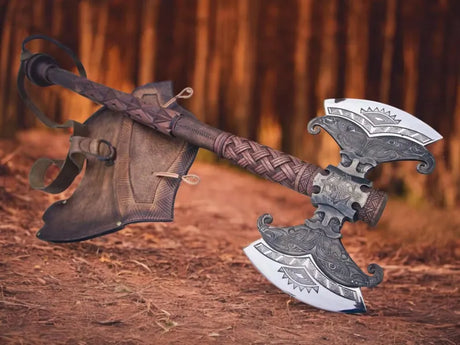
- You may like: Double Sided Battle Axe
Future Projections: The Rebirth of Primal Forces
When we look toward the dramatic conclusion of the Norse mythological cycle, we discover that the story of Ymir does not truly end with his death in the primordial void. The old prophecies regarding Ragnarok reveal that the ancient forces of chaos will eventually break free from the boundaries established by the gods.
[The Slaying of Ymir] ───> [Age of Order / Midgard] ───> [Ragnarok: Breaking Boundaries] ───> [The Eternal Cycle]
During that final, apocalyptic battle, the great oceans created from Ymir’s blood will surge across the dry land, the sky made from his skull will crack open, and the frost giants who trace their lineage directly back to his sleeping sweat will march across the world to challenge the gods.
This cyclical worldview suggests that chaos can never be permanently destroyed; it can only be temporarily organized. The elemental forces contained within Ymir’s original form will always exist beneath the surface, waiting for the moment when the structures of order grow weak, ensuring that the eternal dance between creation and destruction will continue forever.
Conclusion: The Living Canvas of Existence
Ultimately, the ancient narrative of Ymir stands as a magnificent testament to the enduring power of human imagination and our deep desire to find meaning in the world around us. He reminds us that creation and destruction are not opposite forces, but two sides of the exact same coin, intimately bound together in a continuous cycle of cosmic transformation.
He did not build grand temples or write complex laws, yet his presence is felt in every rock, every wave, and every cloud that shapes our daily horizon. By understanding his profound sacrifice, we learn to look at our physical environment with a renewed sense of wonder and appreciation.
As we retell these ancient epics in our modern homes, we ensure that the memory of the first giant remains alive, adding his foundational chapter to the timeless tales of valhalla.