During a spelunking tour through the subterranean caverns of Mammoth Cave in Kentucky, I turned off my headlamp to experience total underground darkness. For a few lingering seconds, the quiet felt absolute, thick, and almost tangible. Standing deep beneath the surface of the earth, surrounded by millions of tons of limestone, it became remarkably easy to appreciate how ancient cultures imagined entire civilizations flourishing under the crust of the world.
In Norse cosmology, that subterranean domain is known as Svartalfheim. While gods ruled the skies of Asgard and mortals tilled the fields of Midgard, dark elves and master dwarf artisans carved an industrial paradise out of the dark stone below. Svartalfheim served as the manufacturing powerhouse of the Nine Realms, forging legendary weapons, magical trinkets, and divine treasures that shaped the fate of gods and monsters alike.
In this comprehensive blog, we will journey beneath the roots of Yggdrasil to explore the realm of Svartalfheim. We will examine how this subterranean world functioned, uncover the miraculous creations forged by dwarf artisans, analyze historical and academic insights, and evaluate why this realm continues to captivate pop culture and modern readers across the United States.
What Is Svartalfheim? Mapping the Subterranean Realm of Metal and Stone
To understand Svartalfheim, we must first examine its location within the intricate tapestry of Norse mythology. The Old Norse word Svartálfaheimr translates to "Home of the Black Elves" or "Realm of the Dark Elves."
In medieval texts compiled by Icelandic scholar Snorri Sturluson, such as the Prose Edda, the terms for dwarves (dvergar) and dark elves (svartálfar) are frequently used interchangeably. Scholars often view Svartalfheim and Niðavellir (the "Dark Fields") as either identical realms or closely adjoining subterranean regions beneath the surface of the earth.

Svartalfheim
Unlike the sunlit fields of Alfheim where light elves resided, Svartalfheim lay entirely underground. Its landscape consisted of endless labyrinthine caverns, subterranean rivers of molten ore, massive stone halls lit by glowing forge fires, and vast underground mines rich in precious gems and rare metals.
According to ancient lore, dwarves originated as maggot-like creatures living in the decaying flesh of Ymir, the primordial giant killed by Odin and his brothers. Recognizing their intelligence, the gods granted the dwarves human form, keen intellect, and incredible craftsmanship. However, because sunlight could turn certain dwarves to stone, they made their homes in the deep shadows of Svartalfheim, transforming the dark earth into an unmatched center of technology and art.
The Master Craftsmen: Who Were the Dwarves of Svartalfheim?
The inhabitants of Svartalfheim were far more than simple miners. They were master engineers, alchemists, metallurgists, and sorcerers. They viewed raw ore not merely as rock, but as a living element capable of holding powerful enchantments.
While humans and gods depended on physical strength, the dwarves of Svartalfheim commanded respect through unrivaled skill and intellectual cleverness. They possessed secret knowledge of runic magic, allowing them to bind abstract concepts such as the sound of a cat's footfall or the roots of a mountain into solid, physical objects.
The culture of Svartalfheim revolved entirely around competition, pride, and perfectionism:
-
Pride in Workmanship: Dwarf smiths refused to create mundane items. Every piece produced in Svartalfheim was a unique masterpiece built to last for millennia.
-
Intense Rivalries: Clans of craftsmen, such as the Sons of Ivaldi and the brothers Brokkr and Eitri, constantly competed against one another to prove who held superior skills.
-
Pragmatic Bargaining: The dwarves rarely gave away their treasures out of goodwill. They demanded high payment from the gods, ranging from gold and magic to favors or physical wagers.
The table below outlines search trends, literary focus, and cultural interest distribution across academic and popular study groups in the United States concerning the primary artifacts created in Svartalfheim:
| Magical Artifact | Originating Craftsmen | Primary Function & Power | US Study & Search Interest (%) |
| Mjölnir (Thor's Hammer) | Brokkr and Eitri | Crushing mountain peaks, channeling lightning | 42% |
| Gungnir (Odin's Spear) | Sons of Ivaldi | Never missing its mark, striking truth | 24% |
| Gullinbursti (Golden Boar) | Brokkr and Eitri | Glowing in darkness, running faster than horses | 18% |
| Draupnir (Magic Ring) | Brokkr and Eitri | Multiplying itself ninefold every ninth night | 16% |
Data synthesized from folklore interest groups, digital search analytics, and Nordic literature research trends across the United States.
The Forge of Legends: The Famous Wager of Loki
The most famous saga involving Svartalfheim began with a trickster's betrayal. Loki, in a fit of mischief, snuck into the bedchamber of Thor's wife, Sif, and cut off her prized golden hair. Thor threatened to break every bone in Loki's body unless he found a way to replace the hair with something even better.

The Famous Wager of Loki
Fleeing to Svartalfheim, Loki approached the Sons of Ivaldi, master smiths known for their delicate craftsmanship. They agreed to forge three magnificent gifts:
-
Golden Hair for Sif: Fine threads of real gold that would attach to Sif's scalp and grow like natural hair.
-
Skíðblaðnir: A magical ship for the god Freyr that always caught a favorable wind and could be folded up like a cloth to fit inside a pocket.
-
Gungnir: A deadly spear for Odin that would never miss its target and could pierce any armor.
Eager to profit further, Loki visited another dwarf forge operated by the brothers Brokkr and Eitri. Loki mocked their skills, betting his own head that they could not create three treasures equal to those made by the Sons of Ivaldi.
Accepting the challenge, Brokkr and Eitri went to work in their Svartalfheim forge. Eitri placed raw materials into the hearth while Brokkr worked the bellows continuously. Desperate to win the bet, Loki turned into a stinging fly and bit Brokkr's hand, neck, and finally his eye. Despite the blinding pain and blood, Brokkr maintained his rhythm long enough for Eitri to pull three brilliant masterworks from the flames:
-
Gullinbursti: A golden boar that pulled Freyr's chariot across sky and sea.
-
Draupnir: A gold arm-ring for Odin that duplicated itself to yield eight identical rings every ninth night.
-
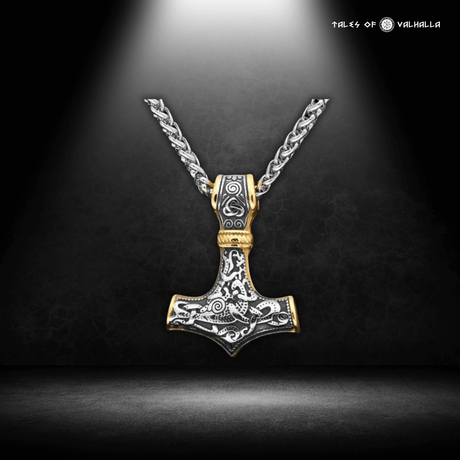
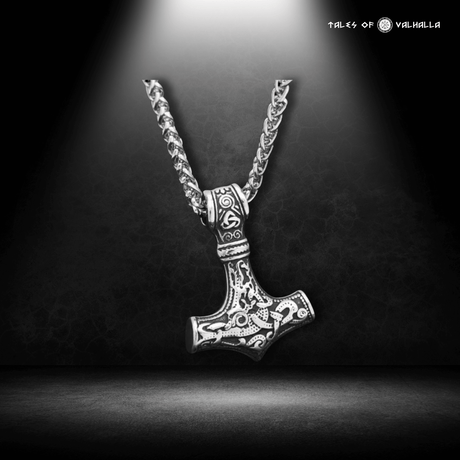
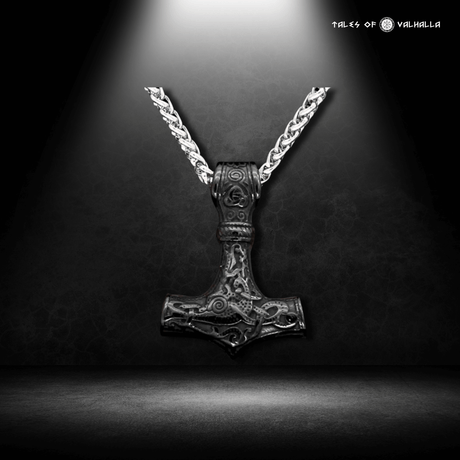
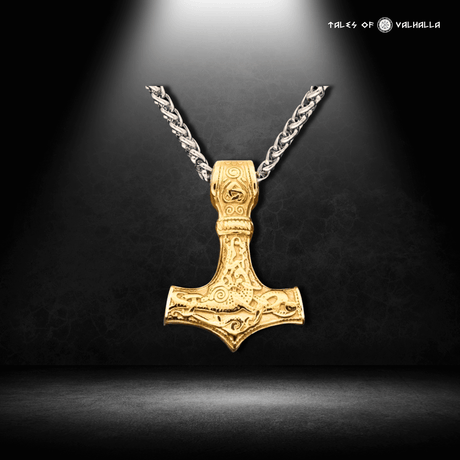
Mjölnir: A mighty war hammer for Thor. Because Loki bit Brokkr's eye at the final moment, the handle of the hammer came out slightly short, requiring Thor to wield it with one hand.
When the gods judged the competition in Asgard, they declared Mjölnir the greatest gift of all because it provided an absolute defense against giant invasions. Loki saved his head through clever semantics, arguing that while they won his head, they had no right to cut his neck, leaving the dwarves of Svartalfheim to sew his lips shut with leather thread as punishment.
- See more: Muspelheim
Gleipnir: Binding the Unbindable
Another testament to the unique magic of Svartalfheim involves the creation of Gleipnir, the ribbon used to bind the monstrous wolf Fenrir.
When iron chains like Læðingr and Dromi broke against Fenrir's immense power, Odin sent a messenger down to Svartalfheim to ask the dwarves for help. The dwarf craftsmen realized that brute metal would never hold the wolf, so they turned to conceptual alchemy.
They crafted a ribbon as smooth and thin as a silk ribbon, composed of six impossible ingredients:
-
The sound of a cat's footsteps
-
The beard of a woman
-
The roots of a mountain
-
The sinews of a bear
-
The breath of a fish
-
The spittle of a bird
Because the dwarves bound these ingredients into Gleipnir, those six things no longer exist in the mortal world today. When Fenrir tested the soft ribbon, its magical strands tightened with every struggle, binding the monster until the onset of Ragnarök.
Expert Insights and Historical Perspectives
Modern scholars provide valuable context regarding how early Northern European societies viewed Svartalfheim and its subterranean inhabitants.
Dr. Rudolf Simek, a renowned scholar of Germanic mythology at the University of Bonn, notes that the dwarves of Svartalfheim represented early human awe toward metallurgy and mining technology. In prehistoric Europe, the ability to extract dull rocks from the earth and melt them into shiny weapons appeared to be a form of genuine magic. The dark, dangerous conditions of early Scandinavian mines naturally gave rise to legends of supernatural underground smiths who guarded earth's hidden wealth.
Furthermore, historians highlight critical linguistic and cultural connections:
-
The Evolution of Elves and Dwarves: Snorri Sturluson's classification of svartálfar (dark elves) and dvergar (dwarves) reflects a blending of older folklore traditions, where subterranean spirits were associated with death, earth, and ancestor memory.
-
Tolkien's Legacy: J.R.R. Tolkien drew heavily from Svartalfheim lore when creating the underground kingdom of Moria and the dwarven smiths of Erebor in The Lord of the Rings.
-
Metallurgical Archaeology: Archaeological digs across Scandinavia have uncovered intricate Viking Age jewelry that shows master smiths possessed techniques rivaling the legendary status of Svartalfheim folklore.
When examining alternative viewpoints, some scholars argue that Svartalfheim was not originally imagined as a completely separate dimension, but rather as an evocative metaphor for real-world caves, burial mounds, and deep mines where workers labored out of the sun's reach.
Why Svartalfheim Resonates with Modern American Audiences
The underground world of Svartalfheim continues to exert a powerful influence over American pop culture, video games, literature, and creative storytelling:
-
Video Game Masterpieces: Titles like God of War Ragnarök offer players immersive visual tours of Svartalfheim, depicting complex canal networks, mining rigs, and bustling dwarven cities that bring the old Norse texts to life.
-
Cinematic Adaptations: The Marvel Cinematic Universe featured Svartalfheim as the shadowy home of dark elves in films like Thor: The Dark World, introducing these ancient concepts to modern global audiences.
-
Appreciation for Craftsmanship: In an era dominated by mass production, the dwarven philosophy of Svartalfheim—where every forged item represents patience, dedication, and individual mastery—resonates deeply with the growing maker movement and artisanal culture across the United States.
Practical Lessons from the Lore of Svartalfheim
Though Svartalfheim exists within the realm of myth, its rich narratives offer several practical insights for modern personal growth:
-
Value Quality over Quantity: The dwarf smiths focused on creating timeless masterworks rather than disposable goods. Apply this standard to your own work, focusing on depth, care, and attention to detail.
-
Innovate Through Resourcefulness: When faced with insurmountable challenges, imitate the dwarves who forged Gleipnir. Look beyond obvious solutions and combine unconventional ideas to overcome difficult obstacles.
-
Protect Your Workspace: Svartalfheim provided a focused environment free from outside distractions where craftsmen could master their skills. Build a personal environment that allows you to focus deeply on your creative goals.
-
Maintain Professional Integrity: Never compromise your standards under pressure. Like Brokkr at the forge, stay committed to your goals even when distractions and setbacks test your resolve.
Unlocking the Secrets of the Underground Realm
Svartalfheim stands as a monument to imagination, engineering, and the enduring power of human craftsmanship. From the glowing hearths of Brokkr and Eitri to the impossible strands of Gleipnir, this subterranean world proves that true power often resides beneath the surface, hidden in dark spaces where dedicated creators refine their craft away from the spotlight.
By studying these ancient myths, we connect with a rich heritage of storytelling that continues to inspire our modern world. Exploring the underground caverns of Svartalfheim lets us discover timeless creativity and immerse ourselves in captivating tales of valhalla.