Imagine stepping into a smoke-filled forge in ninth-century Scandinavia. The rhythmic strike of iron against iron echoes through the timber walls. Sparks dance in the dim light like trapped fireflies. A master blacksmith plunges a glowing red blade into a barrel of oil, unleashing a violent hiss and a cloud of dense steam.
Through this intense, exhausting ritual, the smith creates something far greater than a mere weapon. He gives birth to an ultimate status symbol, a sacred family heirloom, and a highly advanced piece of ancient engineering.
For centuries, pop culture has painted a distorted picture of the Norse people. Entertainment media often portrays them as lawless berserkers swinging crude, oversized axes. The archaeological reality is far more sophisticated.
The people of the early medieval North were brilliant navigators, global traders, and exceptional artisans. Nothing embodies this high level of culture better than authentic Viking Swords. These weapons stand today as timeless masterpieces of Norse craftsmanship, representing a perfect intersection of utility, artistic expression, and spiritual belief.
This comprehensive guide explores the deep, multifaceted history of these iconic blades. We will break down their advanced engineering, clarify their cultural significance, examine the legendary Ulfberht blades, and review their enduring legacy in modern times.
The Historical Roadmap of Our Exploration
To fully appreciate these legendary weapons, we must look beyond the surface level of myth. Our analysis follows a structured journey through history and science:
- Social Reality: Exploring who actually owned these blades and why they were so rare.
- Metallurgical Engineering: Examining the complex process of pattern welding and blade design.
- The Ulfberht Mystery: Analysing the famous crucible steel blades that changed the face of medieval warfare.
- Cultural and Spiritual Echoes: Understanding how named weapons linked warriors to the divine.
- Modern Replications and Legacy: Looking at how today's artisans preserve these ancient traditions.
The True Value of a Blade in the Norse World
To understand the impact of Viking Swords, we must first dispel a major historical misconception. Not every Norse raider or farmer carried a sword into battle. In reality, these weapons were incredibly rare and exceptionally expensive luxury items.
Most everyday Norsemen fought with spears, axes, or large single-edged knives called seaxes. Axes and spears required significantly less iron to produce and utilized simpler blacksmithing techniques.
A sword, by contrast, was the modern equivalent of a high-end sports car or a bespoke luxury watch. It signaled immense wealth, noble lineage, and high social standing.

Viking Swords: Timeless Masterpieces of Norse Craftsmanship
The Economic Cost of Leadership
Historical legal texts and economic records from the early Middle Ages help us calculate the true financial value of these weapons. A standard, undecorated sword cost roughly the same as three to four healthy milk cows.
If a warrior wanted a highly decorated hilt featuring silver wire inlays and geometric carvings, the price could easily soar to the value of sixteen cows or an entire estate.
Because iron extraction from bog ore was a tedious, low-yield process, a single blade represented hundreds of hours of manual labor. This massive economic barrier meant that only jarls (Norse nobles), wealthy chieftains, and elite members of a king's personal guard could afford them.
When you look at Viking Swords, you are looking at the material wealth of the upper echelons of Norse society. They were highly prized assets passed down through multiple generations, accumulating honor and prestige with every conflict.
Anatomy and Technical Evolution of the Blade
The classic Norse sword did not appear overnight. It evolved directly from the Roman Spatha, a long, straight weapon used by cavalry units.
Over the course of three centuries, Northern European blacksmiths modified this design to fit their unique style of shield-wall warfare. The resulting weapon was perfectly optimized for devastating, close-quarters cutting strikes.
Key Structural Components
To understand how these weapons handled, we can look at their distinct anatomical features:
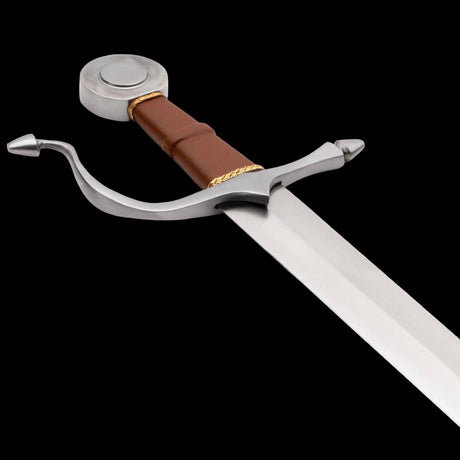
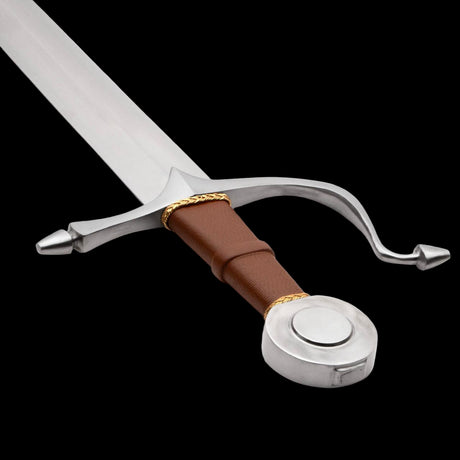
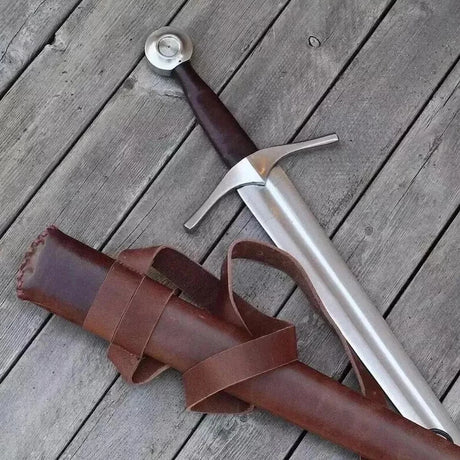
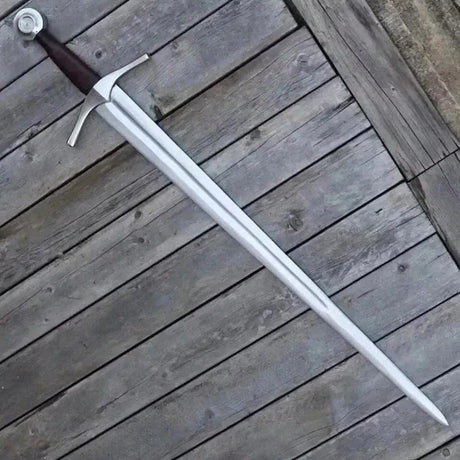
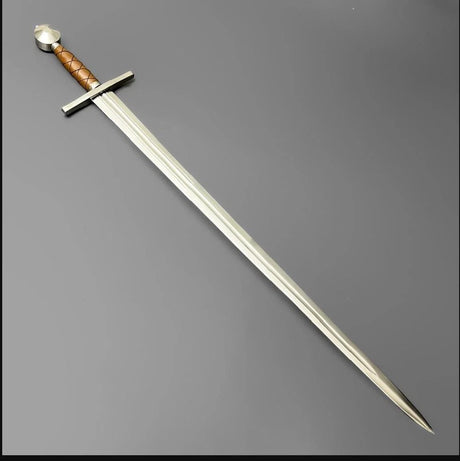
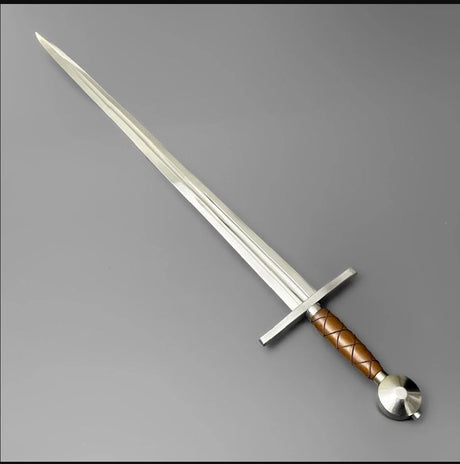
- The Blade: Typically double-edged and measuring between 28 and 36 inches in length. It featured a broad profile that tapered gently toward a relatively rounded point. This design proves that the weapon was built primarily for hacking and slicing rather than thrusting.
- The Fuller: A broad, shallow groove running down the center of both sides of the blade. Many people mistakenly refer to this as a blood groove. In reality, the fuller was an engineering stroke of genius. By removing excess metal from the center of the blade without sacrificing structural integrity, it significantly reduced the weapon's overall weight.
- The Hilt: Composed of a short guard, a one-handed grip, and a prominent pommel. The guard was intentionally kept small to avoid catching on the edges of the user's large round shield.
- The Pommel: A heavy weight attached to the very top of the hilt. It served a vital mechanical purpose by acting as a counterweight to the long blade, pulling the balance point back toward the hand to make the weapon incredibly fast and responsive.
Metrical Data and Material Proportions
The following dataset illustrates the physical dimensions and structural proportions of typical historic models based on extensive museum surveys of well-preserved artifacts:
| Structural Design Element | Typical Measurement Range | Primary Engineering Function |
| Total Length | 35 to 41 inches | Maximizes reach while maintaining quick handling in tight shield walls |
| Blade Width at Guard | 2.0 to 2.4 inches | Provides a wide cutting edge and distributes mechanical impact forces |
| Total Weight | 1.9 to 2.6 pounds | Keeps the weapon light enough to prevent muscle fatigue during long fights |
| Point of Balance | 4.5 to 7.0 inches from guard | Shifts weight toward the tip to maximize the momentum of cutting strikes |
| Fuller Width | 30% to 50% of blade width | Reduces total steel mass by up to 20% while maintaining rigidity |
The Genius of Pattern Welding
The greatest challenge facing an ancient blacksmith was the poor quality of local iron. Bog iron extracted from Scandinavian wetlands was often riddled with impurities and had a dangerously low carbon content.
If a blade contained too little carbon, it would bend easily in battle. If it contained too much carbon, it became brittle and would shatter upon hitting a shield.
To solve this problem, Norse craftsmen perfected a highly complex technique known as pattern welding. This process was a mechanical necessity born from scarcity, but it resulted in breathtaking works of structural art.
The Mechanics of the Forge
Blacksmiths began the process by taking alternating rods of low-carbon iron and high-carbon steel. They bound these rods together, heated them in the forge until they reached a white-hot state, and hammered them into a single, unified bar through forge welding.
Next, the smith would twist the glowing bar like a piece of dough. They would then stack multiple twisted bars side-by-side and weld them to a solid, high-carbon steel edge piece.
When the completed blade was ground down and etched with mild organic acids, a stunning, undulating pattern emerged on the surface. These designs resembled flowing water, twisting vines, or herringbone weaves.
This striking visual pattern was not just decorative. It was a visible map of structural strength.
The low-carbon iron elements provided incredible flexibility, allowing the blade to absorb heavy impacts without snapping. Meanwhile, the high-carbon steel edges gave the weapon a razor-sharp, durable cutting border. Through pattern welding, ancient smiths successfully transformed imperfect raw materials into high-performance tactical tools.

The Mechanics of the Forge
The Ulfberht Mystery: Ancient High-Tech Warfare
Around the late eighth century, an incredible technological leap completely disrupted the traditional European weapon market. A new class of weapons appeared that outperformed pattern-welded blades in every metric.
These elite weapons bore a bold inscription forged directly into the steel: +ULFBERHT+.
+ U L F B E R H T +
These specific Viking Swords represent one of the greatest achievements in medieval metallurgy. For decades, modern scientists were baffled by how these blades were manufactured, as their purity levels defied the known capabilities of the era.
The Science of Crucible Steel
When modern researchers conducted chemical analyses on genuine Ulfberht artifacts, they discovered that these weapons were made from crucible steel. This material was completely free of the slag impurities that plagued standard European iron.
To create crucible steel, iron and carbon materials must be heated inside a sealed clay vessel to temperatures exceeding 3,000 degrees Fahrenheit. At this extreme heat, the iron melts completely, allowing impurities to float to the top where they can be easily skimmed away.
The mystery stems from the fact that European furnaces in the Viking Age could not achieve these temperatures. Blacksmiths in Europe did not officially reinvent this industrial process until the Industrial Revolution in the eighteenth century.
Connecting the Global Silk Road
So, how did Norse warriors obtain this futuristic technology? The answer lies in their massive, far-reaching eastern trade networks.
Norse merchants regularly traveled down the Volga and Dnieper rivers, crossing the Caspian Sea to reach Baghdad and the heart of the Asian Silk Road. In these Middle Eastern trade hubs, they encountered high-quality crucible steel known today as Damascus or Wootz steel, which was produced in India and Central Asia.
Recognizing the immense value of this material, Norse traders brought these steel ingots back to workshops in the West. Archaeologists believe the name Ulfberht originated in the Frankish empire, where highly skilled master smiths used this imported steel to forge unmatched weapons for the elite market.
Spotting the Medieval Counterfeits
Because Ulfberht weapons were so superior, they quickly became targets for fraud. Due to high demand, less skilled blacksmiths began producing cheap, lower-grade imitations to trick eager buyers.
Interestingly, these ancient fraudsters often made subtle spelling errors in their inscriptions. While authentic crucible steel blades feature the signature spelling +ULFBERHT+, many lower-quality imitations discovered in graves are inscribed with variations like +ULFBERH+T.
This proves that brand counterfeiting and intellectual property theft are by no means exclusive to the modern era.
Sacred Identity: The Spiritual Role of the Blade
In the modern world, a weapon is viewed merely as an inanimate object. To the Norse mind, a sword was a living, breathing entity with its own unique personality, destiny, and spiritual weight.
This deep spiritual connection is a major reason why Viking Swords remain timeless masterpieces of Norse craftsmanship. They were intimately tied to their owner's soul and reputation.
The Power of Naming a Blade
The rich tradition of naming weapons is heavily documented throughout the Icelandic Sagas. A warrior did not simply own a sword; they formed a lifelong partnership with it. Weapons received names that reflected their deadly performance, aesthetic beauty, or inner spirit:
- Leg-Biter: The famous sword of King Magnus III of Norway.
- Foot-Breather: A weapon celebrated for its terrifying speed and reach in combat.
- Viper: Named for the slithering, organic patterns running down its pattern-welded blade.
Giving a weapon a name elevated it from a simple tool to a historical actor. The sagas describe these blades as possessing a fierce will of their own. Some weapons refused to be drawn from their scabbards if they felt the cause was unjust, while others were said to hum with an eerie energy when a battle neared.

The Power of Naming a Blade
Sentinels of the Burial Mound
This profound bond extended far beyond the limits of earthly life. When a wealthy Norse warrior died, their sword played a central role in their funeral rites.
To ensure the weapon accompanied its master into the afterlife, it was buried alongside them inside their boat grave or earth mound. However, before the weapon was placed in the ground, it often underwent a ritual execution known to modern archaeologists as sword bending.
The blacksmith or family members would heat the blade and bend it into a useless U-shape, or hammer it until it cracked. This ritual served two distinct purposes:
- Spiritual Release: It effectively killed the weapon, freeing its spirit so it could serve its master in the halls of Valhalla.
- Theft Prevention: It rendered the incredibly valuable blade completely useless, protecting the burial site from grave robbers looking for quick wealth.
Alternative Perspectives: Tool of War or Decorative Prop?
While it is easy to romanticize these legendary weapons, we must also consider a more nuanced, critical historical perspective. Some contemporary scholars argue that our modern view of these swords is heavily distorted by burial biases.
Because swords were luxury status symbols, they were far more likely to be buried in wealthy graves than everyday farm tools or basic spears. This means our modern museum collections display a disproportionately high percentage of swords compared to what was actually used on the average battlefield.
Furthermore, dynamic combat experiments conducted by modern historical martial artists reveal that a sword was not always the most effective weapon choice. In a tight, heavily armored shield wall, a long spear or a compact hand axe offered far better leverage and utility than a sword.
A sword required significant space to swing effectively. If a warrior was packed tightly into a dense formation, swinging a blade risked striking their own comrades.
Therefore, it is highly probable that many of the most heavily decorated swords discovered by archaeologists served primarily as ceremonial dress pieces. They were worn at political assemblies and legal trials to display wealth, rather than being used as everyday frontline combat tools.
- See more: Vali
The Modern Legacy of the Norse Blacksmith
Today, the art of the ancient North is experiencing an incredible global revival. Modern bladesmiths, historical re-enactors, and dedicated collectors are working tirelessly to keep these ancient forging traditions alive.
Preserving a Craft in the Digital Age
Recreating a historically accurate Norse sword using traditional methods is an incredible test of skill. It requires an intimate understanding of thermodynamics, metallurgy, and historic art.
Modern artisans must source clean iron ores, build custom charcoal-fueled forces, and spend weeks folding and twisting steel rods by hand to mirror the historic pattern-welding process. Through this demanding work, modern smiths gain a profound appreciation for the sheer brilliance of ancient craftsmen who achieved these beautiful results without electricity, digital thermometers, or industrial hydraulic presses.
These modern replicas are highly sought after by collectors who want to hold a tangible piece of history in their hands. They serve as a bridge across a thousand years, allowing us to connect directly with the grit, artistry, and vision of the early medieval world.
Echoes of the Forged Blade
Viking Swords remain timeless masterpieces of Norse craftsmanship because they are far more than simple iron tools. They represent a stunning combination of advanced chemical engineering, artistic dedication, and profound spiritual belief.
From the twisted, flowing patterns of the pattern-welded blade to the pristine, imported crucible steel of the legendary Ulfberht workshops, these weapons show us a society that was deeply innovative and globally connected. They remind us that the people of the ancient North were true masters of their material world.
Whether resting silently beneath glass cases in modern museums or being carefully forged anew by contemporary artisans, these swords continue to capture our collective imagination. They stand as enduring symbols of an era defined by bold exploration, fierce independence, and unforgettable artistry.
As we look back at these incredible creations, we preserve the memory of the master smiths who forged them and the legendary warriors who carried them into history. Their stories are forever etched into the steel, waiting to be rediscovered by every new generation that hears the timeless tales of Valhalla.