When I stood inside the Viking Ship Museum in Oslo a few years ago, the faint scent of preserved oak and ancient sea air seemed to fill the hall. What caught my breath was not just the sheer scale of the Oseberg ship, but the intricate wood carvings coiling along its prow. I watched visitors lean in close to marvel at the wooden beasts intertwined in eternal struggle.
Popular media often paints the Norse world in monochrome shades of mud, blood, and cold steel. Yet the physical reality tells a completely different story. Norse craftsmen were master visual storytellers who filled their everyday lives with vibrant, complex artwork. Understanding Viking Art Styles allows us to look beyond popular legends and appreciate an extraordinary artistic legacy that transformed early medieval Europe.
In this historical guide, we will trace the evolution of Viking Art Styles across three centuries, examining how Scandinavian artisans adapted their visual language as their world expanded through trade, exploration, and cultural exchange.
What Defines Viking Art Styles?
To appreciate Norse craftsmanship, we must first understand its core visual language. Unlike classical Mediterranean art, which focused heavily on realistic human anatomy and geometric symmetry, Scandinavian artists preferred abstract, flowing forms dominated by animal motifs.
Art historians refer to these stylized creatures as zoomorphic motifs. Artisans depicted gripping beasts, mythical serpents, predatory birds, and majestic horses, weaving them into dense ribbon patterns that covered swords, brooches, runestones, and longships.

Viking Art Styles served functions far beyond simple decoration. They expressed social status, tribal identity, and spiritual protection. A warrior carrying a sword decorated with intricate animal patterns carried the protective favor of the spirits into battle. Furthermore, these designs displayed immense wealth, as commissioning a master craftsman required significant resources.
Dr. Signe Horn Fuglesang, a leading authority on early medieval Scandinavian art, notes that Norse artists constantly balanced rigid traditional rules with bold personal innovation. They adapted metalwork techniques brought back from raids and trade expeditions across Europe, blending continental influences into a distinct northern aesthetic.
| Artistic Era | Key Characteristic | Dominant Material | Primary Cultural Function |
| Oseberg (800 – 875 CE) | Gripping beast motif with rounded bodies | Carved Oak & Bronze | Royal burial displays and prestige goods |
| Borre (850 – 950 CE) | Geometric ring-chain patterns and cat-like heads | Silver filigree & Gilded Bronze | Personal jewelry and daily wear ornaments |
| Jellinge (900 – 975 CE) | Ribbon-like S-shaped animals in profile | Silver tableware & Stone monuments | Royal propaganda and political statements |
| Mammen (960 – 1025 CE) | Folia motifs and grand solitary beasts | Inlaid Iron & Precious Metals | High-status weapons and ceremonial axes |
| Ringerike (980 – 1070 CE) | Taut tendrils, large eyes, and dynamic movement | Weather vanes & Runestones | Commemorative monuments along trade routes |
| Urnes (1050 – 1150 CE) | Slim, looping serpents and delicate lines | Stave church wood & Coinage | Christianized architectural decoration |
The Six Eras of Viking Art Styles
Archaeologists divide the evolution of Norse visual culture into six distinct chronological phases, each named after a major archaeological site or artifact discovery.

The Six Eras of Viking Art Styles
1. The Oseberg Style (c. 800 – 875 CE)
The Oseberg style marks the birth of recognized Viking Art Styles. Discovered in a magnificent ship burial in Vestfold, Norway, this style features the famous gripping beast motif. These creatures possess compact bodies, sharp claws, and expressive eyes as they grasp their own limbs or neighboring borders.
2. The Borre Style (c. 850 – 950 CE)
As Scandinavian trade networks expanded across eastern rivers and western seas, the Borre style gained widespread popularity. Artisans introduced geometric ring-chain knots alongside compact, cat-like animal heads. Due to its popularity among everyday traders and farmers, archaeologists find Borre style bronze brooches throughout Britain, Iceland, and the Baltic regions.
3. The Jellinge Style (c. 900 – 975 CE)
Appearing alongside the late Borre phase, the Jellinge style introduced elongated, ribbon-like animals depicted strictly in profile. These creatures feature pigtail-like crests, lip spirals, and patterned, ribbon-shaped bodies that intertwine smoothly across silver cups and stone carvings.
4. The Mammen Style (c. 960 – 1025 CE)
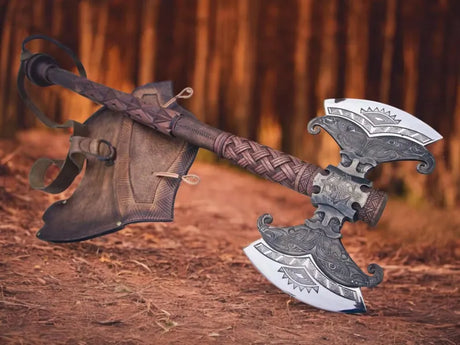
Named after a wealthy warrior grave in Denmark, the Mammen style marks a shift toward grander, more aggressive compositions. Leaves and plant tendrils begin appearing alongside dynamic animals. The famous Mammen ceremonial axe displays a magnificent bird intertwined with foliage, showcasing silver wire inlay techniques of incredible complexity.
5. The Ringerike Style (c. 980 – 1070 CE)
During the late 10th century, Scandinavian artists integrated European continental plant ornaments into their work. The Ringerike style features dramatic, sweeping tendrils surrounding large, almond-eyed beasts. We see this style clearly on bronze ship vanes and stone monuments raised across southern Scandinavia.
6. The Urnes Style (c. 1050 – 1150 CE)
The final phase of traditional Scandinavian art reached its peak inside early Christian stave churches. The Urnes style emphasizes extreme elegance, featuring slender, graceful greyhounds and looping snakes carving deep relief patterns into wooden doorway frames.
Archaeological Trends in Artifact Discoveries
Modern archaeological excavations continue to expand our understanding of how Viking Art Styles spread throughout Northern Europe and North America.
| Region & Excavation Survey | Total Artifact Density | Dominant Art Style Represented | Primary Metal Composition |
| Birka & Gotland (Sweden) | 34% of overall cataloged items | Borre & Jellinge Styles | Cast Bronze & Imported Silver |
| Jutland Peninsula (Denmark) | 28% of overall cataloged items | Oseberg & Mammen Styles | Gilded Copper & Carved Wood |
| York & Dublin (British Isles) | 22% of overall cataloged items | Borre & Ringerike Styles | Worked Iron & Bone/Antler |
| Oslofjord Region (Norway) | 16% of overall cataloged items | Oseberg & Urnes Styles | Carved Oak & Cast Silver |
These statistical distributions show that while certain artistic trends began in specific royal centers, trade routes carried these designs across international borders quickly, creating a shared Northern European culture.
Counterarguments and Alternative Perspectives
While art historians generally agree on these six chronological categories, some modern scholars challenge rigid classification systems. They argue that traditional museum categories create an artificial sense of order that did not exist for historical craftsmen.
For example, real-world workshop finds show that artisans frequently mixed elements from different eras on a single object. A silver brooch crafted in a rural Swedish village might feature Borre knotwork alongside early Jellinge ribbon beasts, proving that stylistic transitions happened gradually over decades rather than overnight.
Furthermore, critics point out that surviving artifacts bias our view toward durable materials like metal, stone, and preserved oak ship timber. Thousands of delicate textiles, painted shields, and leather items have rotted away over time. If more painted textiles had survived, our modern understanding of Scandinavian color palettes and composition might look entirely different.
Despite these limitations, organizing Viking Art Styles chronologically remains the most effective tool for scholars and history enthusiasts to track the evolution of early northern visual culture.
The Legacy of Norse Craftsmanship
The story of Scandinavian art is a journey of constant adaptation, technical mastery, and creative energy. From the playful gripping beasts of the early Oseberg era to the elegant, looping serpents carved onto Urnes stave church portals, these artists transformed functional everyday items into sacred masterpieces.
Today, contemporary jewelers, stone carvers, and digital illustrators continue drawing inspiration from these historical styles. By studying these ancient patterns, we keep the memory of northern craftsmanship alive, ensuring these legendary designs continue to inspire future generations through the timeless tales of valhalla.