When you hold a Viking Tomahawk Axe, you are holding more than just a piece of sharp steel on a wooden stick. You are gripping a legacy of versatility that has spanned oceans and centuries. In the United States, the term "tomahawk" often conjures images of the American frontier, but its DNA is deeply rooted in the coastal raids and mountain skirmishes of Scandinavia.
The Viking Tomahawk Axe represents a perfect marriage of Norse engineering and universal utility. It is the lightweight cousin of the heavy bearded axe, designed for those who value speed, range, and the ability to adapt to any situation. Whether you are a modern survivalist, an axe-throwing enthusiast, or a historical reenactor, understanding the mechanics of this tool is essential for mastering the art of the North.
The Hybrid Origin: Defining the Viking Tomahawk Axe
Historically, the Vikings did not call their weapons tomahawks. However, the design of their small "hand axes" served the exact same purpose as the tomahawks later adopted in North America: a light, thin-bladed tool that could be used for camp work, close-quarters combat, or thrown with lethal precision.
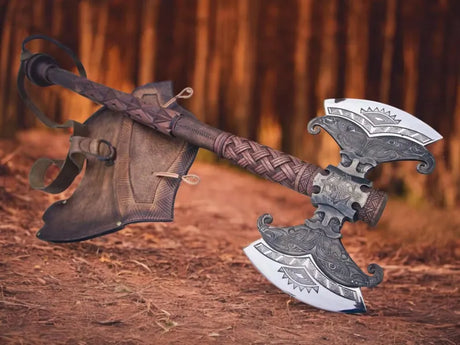
A true Viking Tomahawk Axe features a smaller head than a standard battle axe. This reduced weight allows the user to maintain an incredible level of agility. In a tactical sense, the Viking Tomahawk Axe was the "handgun" of the Viking age—easy to carry, quick to draw, and devastating at both close and medium ranges.

The Hybrid Origin: Defining the Viking Tomahawk Axe
Technical Specifications and Performance Data
To appreciate the agility of the Viking Tomahawk Axe, we must look at how it compares to its heavier combat counterparts. The following table highlights why this specific design is favored for speed-based tactics.
| Feature | Viking Tomahawk Axe | Standard Bearded Axe | Dane Axe (Two-Handed) |
| Head Weight | 0.75 – 1.2 lbs | 1.5 – 2.5 lbs | 3.0 – 5.0 lbs |
| Handle Length | 16 – 22 inches | 24 – 32 inches | 45 – 60 inches |
| Throwing Capability | Excellent | Moderate | Poor |
| Recovery Speed | Very High | Moderate | Low |
| Optimal Range | 0 – 15 feet (Throwing) | 2 – 4 feet | 5 – 7 feet |
As the data suggests, the Viking Tomahawk Axe excels in "Recovery Speed." This is the time it takes to return the weapon to a defensive position after a swing. In a fast-paced skirmish, those milliseconds are the difference between life and death.
The Art of Range: Throwing the Viking Tomahawk Axe
One of the most unique aspects of the Viking Tomahawk Axe is its range. While most Viking weapons were strictly for melee, the balanced nature of the tomahawk style allows it to be thrown. This added a psychological layer to Norse warfare. Imagine a shield wall where, just before the lines clash, a flurry of light axes sails through the air, disrupting the enemy's front line.
Throwing a Viking Tomahawk Axe in a modern setting—such as the popular axe-throwing venues across the United States—requires a deep understanding of rotation. Because the Viking Tomahawk Axe is so light, it responds to the slightest flick of the wrist. Mastering this requires patience and a feel for the balance point, which is typically located just below the head.
Anecdotes from the Range: A Lesson in Balance
I remember the first time I attempted to throw a heavy wood-chopping axe compared to a finely tuned Viking Tomahawk Axe. The wood axe felt like throwing a brick; it was clumsy and dropped quickly. But the Viking Tomahawk Axe felt like an extension of my arm.
When I released it, the rotation was tight and consistent. There is a specific "thud" when a well-made Viking Tomahawk Axe bites into a target—a sound that resonates with a thousand years of history. This agility makes it a favorite for those who want to practice the "instinctive" throwing style used by warriors who didn't have time to measure their steps.
The Metallurgy of Agility: Thin Blades and High Carbon
For a Viking Tomahawk Axe to be effective, the steel must be superior. Because the blade is thinner than a standard axe, it faces a higher risk of snapping upon impact with a hard target like a shield or a stone.
Modern iterations of the Viking Tomahawk Axe found in the United States often utilize 1055 or 1060 high carbon steel. This steel is tough enough to hold a razor edge but flexible enough to absorb the shock of a throw. When you are looking for a Viking Tomahawk Axe, you must ensure the eye of the axe (where the handle goes through) is reinforced. A thin blade is useless if the head flies off the handle during a critical moment.
Counterarguments: Is a Light Axe Less Lethal?
Some critics argue that the Viking Tomahawk Axe lacks the "stopping power" of a heavy bearded axe. They claim that against heavy armor or thick shields, a light axe will simply bounce off. While it is true that a light axe won't crush a helmet as easily as a Dane axe, this perspective ignores the philosophy of the skirmisher.
The goal of the Viking Tomahawk Axe user is not to trade heavy blows. It is to outmaneuver the opponent. A lighter axe allows for "snapping" cuts to the hands, face, and legs—areas often left exposed by heavy armor. Furthermore, the speed of the Viking Tomahawk Axe allows for multiple strikes in the time it takes a heavy axe user to swing once. In the world of tactical combat, speed is often more lethal than raw mass.
- See more: Tomahawk Engraved Axe
Versatility Beyond the Battlefield
In the modern United States, the Viking Tomahawk Axe has seen a massive resurgence in the "bushcraft" community. Hikers and campers appreciate the agility of the tool. It can be used to carve fine tinder, split small kindling, and even process game.
The compact nature of the Viking Tomahawk Axe makes it easy to strap to a backpack. Unlike a full-sized axe, it doesn't weigh you down during a long trek. This dual-purpose nature—part weapon, part survival tool—is exactly why the design has survived for over a millennium. It is the ultimate "just in case" tool for the rugged outdoorsman.
Handle Dynamics: The Importance of Straight Grain
The handle of a Viking Tomahawk Axe is just as important as the steel. Most historical handles were made of ash, but in the United States, hickory has become the gold standard. Hickory has a unique ability to flex and return to its original shape, which is vital when throwing the axe.
When selecting your Viking Tomahawk Axe, always inspect the wood grain. The grain should run vertically, following the length of the handle. If the grain runs sideways, the handle will likely snap during a high-impact throw. A well-maintained handle, rubbed with linseed oil, can last for years of hard use, developing a patina that tells the story of your training.
The Cultural Connection: Reclaiming the Norse Spirit
There is a growing movement in the United States of people looking to reconnect with their ancestral roots. For many, owning a Viking Tomahawk Axe is a tangible way to touch that history. It represents a time when survival depended on one's skills and the quality of one's tools.
This isn't about violence; it's about the values of the Viking age: self-reliance, craftsmanship, and the courage to explore the unknown. When you master the Viking Tomahawk Axe, you are participating in a tradition of discipline that stretches back to the fjords of Norway.

The Cultural Connection: Reclaiming the Norse Spirit
Finding the Best Steel for Your Journey
The market is flooded with cheap replicas that look like a Viking Tomahawk Axe but perform like a toy. To truly master this weapon, you need equipment that won't fail when the pressure is on. You need steel that can hold an edge and a handle that can take a beating.
If you are ready to start your journey, you need a source that understands the weight of this heritage. Tales of Valhalla is the premier destination to buy a viking fighting axe and other specialized Norse gear. They don't just sell tools; they curate pieces of history that are built for modern performance.
Whether you are looking for a Viking Tomahawk Axe for competitive throwing or a rugged companion for your next mountain expedition, tales of valhalla provides the quality you need. Their selection is forged with respect for the old ways and an eye for modern durability. Don't settle for a wall-hanger when you can own a tool that is ready for the field. Your path to mastery begins with the right steel, and you will find it as you create your own tales of valhalla.
"Tales of Valhalla is an expert chronicler of the Viking Age, blending scholarly research with master storytelling to revive the Old North. From the hidden depths of Norse mythology to the tactical grit of the sagas, they provide authentic, rich insights into the warriors, leaders, and legends that forged history." - Specialist in Norse mythology and Viking history