Think of a Viking. You probably picture a towering warrior with a mud-splattered face, tangled hair, and an battle-axe dripping with river water. Pop culture loves the wild barbarian stereotype. However, historical evidence paints a completely different picture. The Norse people of the Early Middle Ages were remarkably meticulous about their appearance. They bathed regularly, combed their hair daily, and decorated their bodies with finely crafted ornaments.
Jewelry was not merely decorative in the Viking world. It functioned as portable wealth, political currency, religious protection, and social status written in metal. From silver arm rings hacked into pieces to trade for grain to intricate Thor's hammer pendants worn to ward off misfortune, jewelry touched every aspect of daily life.
To truly understand what jewelry the Vikings wore, we must look beyond shiny trinkets. We need to explore the craftsmanship, social structures, religious beliefs, and artistic evolution that defined the Norse age.
How Do We Know the Vikings Wore Jewelry?
Our understanding of Viking personal adornment comes from three main sources: archaeological discoveries, written sagas, and accounts from foreign travelers who met the Norse face-to-face.
Archaeologists have unearthed thousands of Norse artifacts across Scandinavia, Britain, Ireland, and Eastern Europe. Among the most remarkable discoveries are vast silver hoards buried underground for safe-keeping during times of unrest.

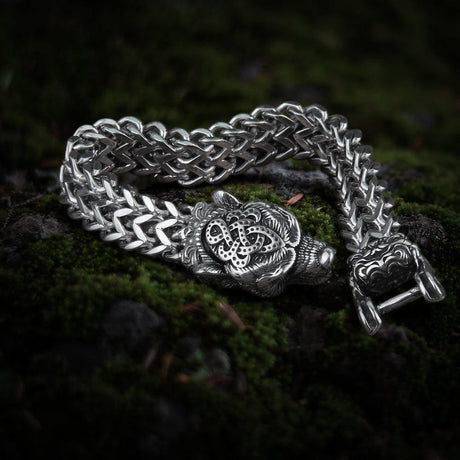
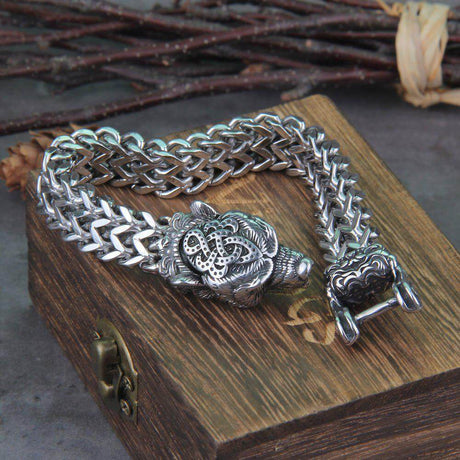
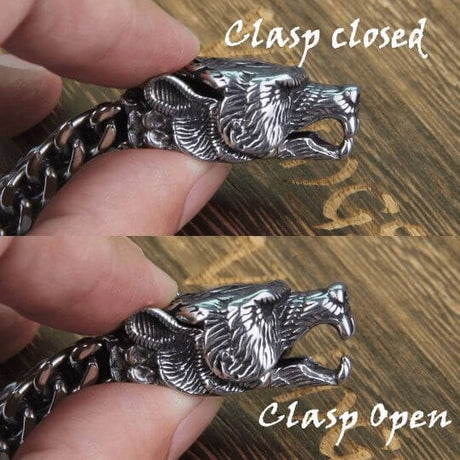
Geri and Freki Wolf Head Torc Bracelet
The famous Silverdale Hoard, discovered in Lancashire, England in 2011, contained over two hundred pieces of silver jewelry and coins. Similarly, the Huxley Hoard from Cheshire revealed twenty-two lead-lined silver arm rings, demonstrating how widespread jewelry ownership was among trading communities.
+---------------------+-----------------------------------+-----------------------------------+
| Discovery / Source  | Location / Origin                 | Historical Significance           |
+---------------------+-----------------------------------+-----------------------------------+
| Silverdale Hoard    | Lancashire, England (2011)        | Over 200 silver arm rings, coins, |
|                     |                                   | and ingots used as silver bullion |
+---------------------+-----------------------------------+-----------------------------------+
| Huxley Hoard        | Cheshire, England (2004)          | 22 silver arm rings decorated     |
|                     |                                   | with intricate punch marks        |
+---------------------+-----------------------------------+-----------------------------------+
| Ibn Fadlan's Journal| Volga River Region (922 AD)       | Eyewitness accounts of Vikings    |
|                     |                                   | wearing silver and gold neck rings|
+---------------------+-----------------------------------+-----------------------------------+
| Anglo-Saxon Chronicle| Anglo-Saxon England              | Records King Guthrum swearing an  |
|                     |                                   | oath upon a sacred holy arm ring  |
+---------------------+-----------------------------------+-----------------------------------+
Written records confirm these physical findings. In 922 AD, an Arab diplomat named Ahmad ibn Fadlan traveled along the Volga River and encountered Rus Vikings. He observed that every woman carried a container of gold or silver on her breast, proportional to her husband's wealth. He noted that men wore heavy silver and gold neck rings, adding a new ring for every ten thousand dirhams their trade earned.
Old Norse sagas and legal texts regularly reference sacred arm rings used to swear solemn oaths. In the Anglo-Saxon Chronicle, King Guthrum famously made peace with King Alfred the Great by swearing an oath on a sacred holy arm ring. These records show that jewelry was central to legal and political trust.
Why Did Vikings Wear Jewelry?
Norsemen and Norsewomen wore jewelry for practical, economic, social, and religious reasons.
Status and Wealth
Viking society was strictly stratified. Kings, jarls, free farmers, and enslaved thralls occupied distinct ranks. Wearing valuable metal was the fastest way to signal power. A wealthy chieftain wore gleaming gold or refined silver. A modest farmer wore bronze or carved bone.
Hack Silver and Bullion Economy
The Vikings operated largely on a bullion economy, where precious metal value depended on weight rather than minted coin values. Necklaces and arm rings were designed to be functional checkbooks. When a trader needed to buy a horse, cattle, or wheat, they simply chopped off a segment of their silver armband and weighed it on handheld scales. Archaeologists call these cut pieces "hack silver."
Practical Fasteners
Clothing in the Viking Age lacked modern buttons, zippers, or elastic bandings. Heavy wool cloaks and linen smocks relied on metal brooches and pins to stay securely fastened against cold Northern winds.
Religious Protection
Faith in the Norse pantheon was deeply personal. Wearing symbolic pendants allowed individuals to invoke protection from gods like Thor or Odin during perilous ocean voyages and brutal battles.
What Kind of Jewelry Did They Wear?
Norse craftspeople produced various types of adornments. They worked primarily with bronze, silver, and gold, occasionally inlaying pieces with semi-precious materials like garnet, amber, and colored glass beads.

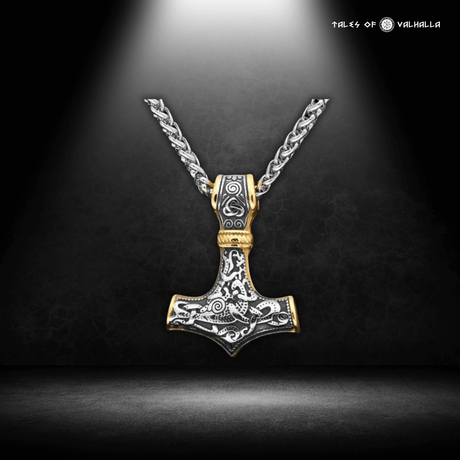
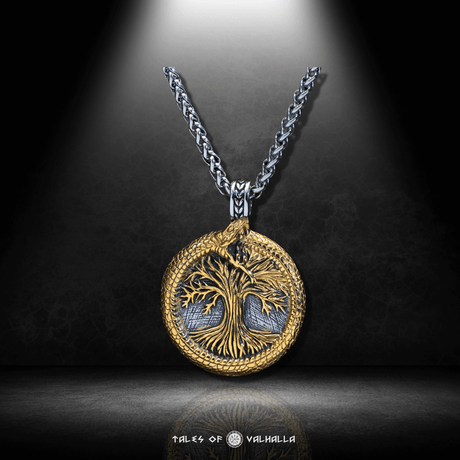
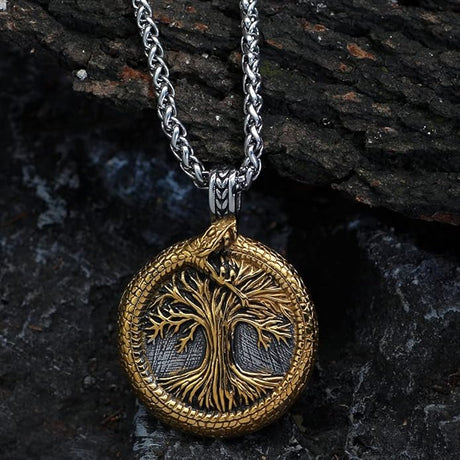
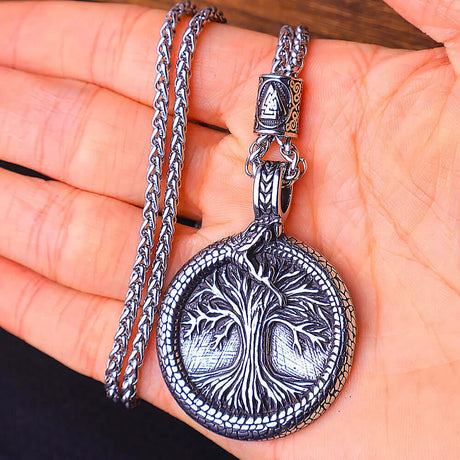
Jörmungandr Surrounding Mjölnir Necklace
Necklaces and Neck Rings
Necklaces were popular across all social classes. Wealthier individuals favored thick, twisted metal neck rings made from solid silver or gold strands braided together.
Other necklaces featured strings of vibrant glass or amber beads imported from the Baltic Sea region. Pendants held deep spiritual meaning:
-
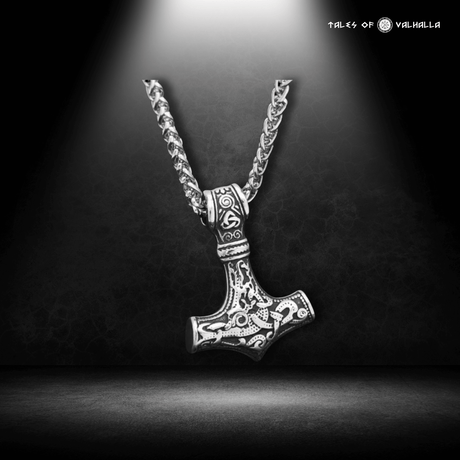
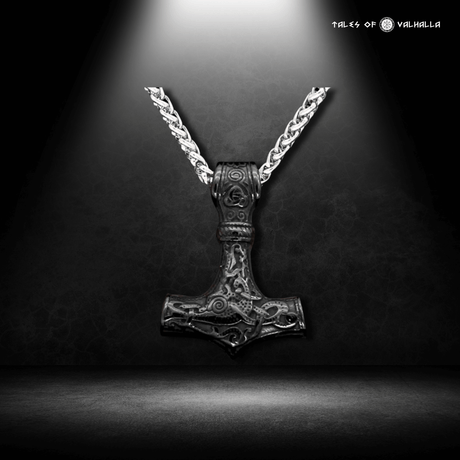
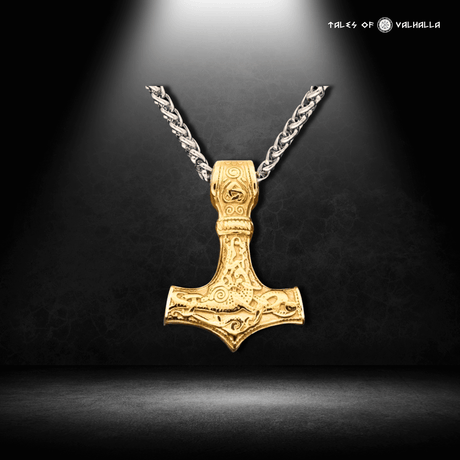
Thor's Hammer (Mjölnir): The most widespread pendant by far. Represents strength, protection, and fertility.
-
Solar Discs: Round metal pendants representing the sun, warmth, and seasonal harvests.
-
Miniature Miniature Tools: Tiny silver axes or sickles symbolizing agricultural productivity and martial skill.
-
Spears (Gungnir): Stick-shaped pendants representing Odin's magical spear that never missed its target.
-
Valkyrie Figures: Small silver pendants depicting women holding drinking horns, representing the maidens who guided fallen warriors to Valhalla.
Armbands and Arm Rings
Arm rings served as status symbols, currency, and social milestones. In many Norse communities, young men received their first silver arm ring during a coming-of-age ritual to signify entry into adulthood and community obligation.
Sagas describe chieftains as "ring-givers." Generous leaders rewarded loyal warriors with heavy silver armbands after successful raids, securing allegiance for future campaigns.
Rings for Fingers
Finger rings became widespread during the mid-to-late Viking Age, likely through trade contact with the Byzantine Empire and Western Europe. Most finger rings featured open-ended or penannular designs. This allowed wearers to adjust the ring size easily without remelting the metal.
Brooches
Brooches were essential wardrobe staples. Women wore paired oval brooches, often called "tortoise brooches" due to their rounded shape, to anchor shoulder straps on pinafore dresses. They often strung strings of colored beads between these two brooches.
Men favored large penannular brooches with long swiveling pins to secure heavy woolen cloaks over their right shoulder, leaving their sword arm completely free for battle.
Beard and Hair Rings
Long hair and groomed beards were sources of pride for Norse men and women. Unruly hair was hazardous in combat or farm work. To keep hair secure, the Vikings used metal hair rings, bone slides, and decorative bands to hold braids neatly in place.
Earrings: A Foreign Trend
Earrings were uncommon in early Scandinavian tradition. Piercing the skin was rare among early Norse people. However, through extensive trade along Eastern European river routes, Vikings encountered Slavic and Byzantine cultures where earrings were fashionable. Over time, Norse travelers adopted silver ear cuffs and clasps that gripped the outer ear without requiring permanent piercings.
Crafting the Metal: The Evolution of Viking Art Styles
The intricate patterns on Norse brooches and pendants were not random doodles. They belonged to distinct artistic movements that evolved over three centuries. Metallurgists used lost-wax casting methods to produce these elaborate designs.
In lost-wax casting, an artisan carved a detailed master design out of beeswax, surrounded it with heat-resistant clay, and baked the mold. As the wax melted away, it left a hollow cavity. The artisan poured molten metal into the mold, cooled it, and broke the clay shell to reveal the metal piece.
The decorative motifs on these pieces reflected changing cultural tastes. Scholars categorize these aesthetics into six major Viking Art Styles:
+------------------+------------------+-------------------------------------------------+
| Style Name       | Era / Period     | Key Visual Characteristics                      |
+------------------+------------------+-------------------------------------------------+
| Oseberg          | 790 – 850 AD     | Broad "gripping beasts" clinging to borders    |
+------------------+------------------+-------------------------------------------------+
| Borre            | 850 – 925 AD     | Ring-chain patterns, geometric knotwork         |
+------------------+------------------+-------------------------------------------------+
| Jellinge         | 900 – 975 AD     | S-shaped ribbon animals with head-crests        |
+------------------+------------------+-------------------------------------------------+
| Mammen           | 960 – 1000 AD    | Larger foliage ribbons, prominent lions/birds   |
+------------------+------------------+-------------------------------------------------+
| Ringerike        | 980 – 1070 AD    | Flowing tendrils, elongated cross-hatching      |
+------------------+------------------+-------------------------------------------------+
| Urnes            | 1050 – 1125 AD   | Ultra-slim, elegant looping ribbon snakes      |
+------------------+------------------+-------------------------------------------------+
The Oseberg Style (c. 790 – 850 AD)
The earliest recognizable trend, named after the famous Oseberg ship burial in Norway. Characterized by compact, muscular creatures called "gripping beasts" that clutch their own limbs or border frames with paws.
The Borre Style (c. 850 – 925 AD)
Named after a royal grave mound in Borre, Norway. Features geometric ring-chain interlace patterns resembling braided ropework. Popular on silver arm rings and everyday bronze brooches.
The Jellinge Style (c. 900 – 975 AD)
Originating in Jelling, Denmark, this aesthetic introduced ribbon-like animals drawn in profile. These ribbon beasts feature elongated bodies that twist smoothly into S-curves.
The Mammen Style (c. 960 – 1000 AD)
Named after a wealthy warrior grave in Denmark. This approach built upon the Jellinge trend by adding naturalistic elements like plant tendrils, foliate leaves, and majestic beasts like lions and eagles.
The Ringerike Style (c. 980 – 1070 AD)
Reflecting growing contact with Christian Western Europe, this style features thin, pear-shaped animal eyes, sweeping plant tendrils, and elaborate cross motifs carved into brooches and runestones.
The Urnes Style (c. 1050 – 1125 AD)
The final flourish of traditional Norse aesthetics, named after the wood carvings of Urnes Stave Church in Norway. Features delicate, slender creatures looping gracefully through thin serpentine coils.
Misconceptions About Norse Jewelry
Modern films and television shows often misrepresent historical details. Clearing up these common myths helps us appreciate real Norse craftsmanship:
-
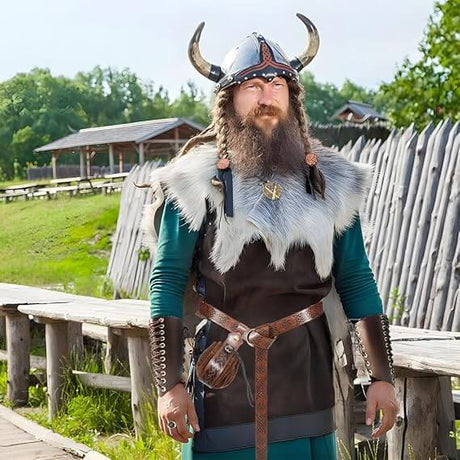
Myth 1: Vikings wore horn-adorned helmets and dark spiked leather jewelry.
-
Reality: Spiked leather armbands are modern fantasy inventions. Authentic Norse jewelry was refined, polished, and intricately carved with animal knotwork.
-
-
Myth 2: Only women wore decorative jewelry.
-
Reality: Men wore heavy silver neck rings, armbands, and elaborate cloak brooches to display wealth and military achievement.
-
-
Myth 3: Jewelry was purely decorative.
-
Reality: Jewelry doubled as wearable wealth. The hack silver system made every silver armband an active financial asset.
-
Bringing Ancient Craftsmanship into the Modern World
The appeal of Norse jewelry endures today. Modern wearers value these historic items for their geometric beauty, rich symbolic meanings, and connection to ancient traditions.
Whether wearing a solid silver Thor's hammer pendant as a sign of personal resilience, or choosing an arm ring decorated with intricate gripping-beast patterns, wearing these pieces connects you directly to the legendary craftsmanship, epic sagas, and enduring tales of valhalla.