In the pantheon of Norse legend, few figures command as much terror and respect as The Fenrir Wolf. A creature of cosmic proportions and apocalyptic significance, Fenrir is not merely a monster of the wild—he is the ultimate symbol of destiny, rebellion, and the primal power that eventually consumes even the gods themselves.
Whether you are a student of Viking history, a fan of modern fantasy, or a collector of Norse-inspired artifacts, understanding the saga of The Fenrir Wolf is essential. This guide dives deep into the origins, the binding, and the ultimate vengeance of the Great Wolf, exploring why his legend remains an unstoppable force in 2026.
The Origins of a Monster: Son of Loki
The Fenrir Wolf (also known as Fenrisúlfr) was born from the chaotic union of the trickster god Loki and the giantess Angrboda. He was one of three monstrous siblings, alongside Jörmungandr (the Midgard Serpent) and Hel (the goddess of the underworld).
When the Aesir gods of Asgard received prophecies that these three children would bring about their downfall, they took drastic measures. While Jörmungandr was cast into the sea and Hel was sent to rule the realm of the dead, Fenrir was brought to Asgard. The gods hoped that by raising the wolf among them, they could keep his ferocity under control. They were wrong.

The Fenrir Wolf
The Growing Shadow: Why the Gods Feared Fenrir
As Fenrir grew, his size and strength increased at an alarming rate. He eventually became so large that his upper jaw touched the sky while his lower jaw rested on the earth. Only Tyr, the god of war and justice, was brave enough to approach the wolf to feed him.
The gods realized that The Fenrir Wolf could not be tamed. Fearing the prophecy of Ragnarök—the end of the world—they decided he must be bound. However, Fenrir was too strong for any ordinary chain.
The Three Chains of Asgard
To trick Fenrir into being bound, the gods framed it as a test of his strength.
- Leyding: A heavy iron chain. Fenrir snapped it with a single kick.
- Dromi: A chain twice as strong as the first. Fenrir shattered it into a thousand pieces.
- Gleipnir: Fearing they had no more options, the gods turned to the Dwarves (the Svartálfar). They forged Gleipnir, a tether that looked as thin and smooth as a silk ribbon but was made from six impossible ingredients: the sound of a cat's footfall, the beard of a woman, the roots of a mountain, the sinews of a bear, the breath of a fish, and the spittle of a bird.
The Sacrifice of Tyr and the Binding of Fenrir
Fenrir, suspicious of the thin ribbon, agreed to be bound only if one of the gods placed their hand in his mouth as a pledge of good faith. Only Tyr stepped forward.
When The Fenrir Wolf realized he could not break free from Gleipnir, he bit off Tyr’s hand. The gods then took a sword and shoved it into Fenrir's open jaws, the hilt against the lower jaw and the point against the upper, gagging him. He remained bound on the island of Lyngvi, his howls echoing through the ages, while the river Ván (Expectation) flowed from his drooling jaws.
Ragnarök: The Wolf Unbound
The legend of The Fenrir Wolf does not end with his imprisonment. Norse mythology is a cycle of fate, and the binding was only a delay.
As the events of Ragnarök begin, the earth will tremble, and the magical tether Gleipnir will snap. Fenrir will run across the world with eyes and nostrils flaming. Most famously, Fenrir is destined to fulfill the darkest prophecy of all: he will swallow Odin, the All-Father, whole.
Though Fenrir is eventually slain by Odin’s son, Vidar, his role as the "God-Slayer" cements him as the most formidable adversary in the Viking cosmos.
Symbolism of The Fenrir Wolf in Modern Culture
In 2026, the image of The Fenrir Wolf has evolved beyond a simple villain. To many, he represents:
- The Untameable Spirit: The refusal to be bound by society or the "gods" of the status quo.
- The Power of Nature: A reminder that despite our walls and chains, the wild forces of the world will always have the final word.
- Inevitable Fate: The courage to face a destiny that is already written, no matter how dark it may be.
For enthusiasts of Viking heritage, Fenrir is often seen as a symbol of ferocity in battle and the loyalty of the pack.
Crafting the Legend: The Fenrir Aesthetic
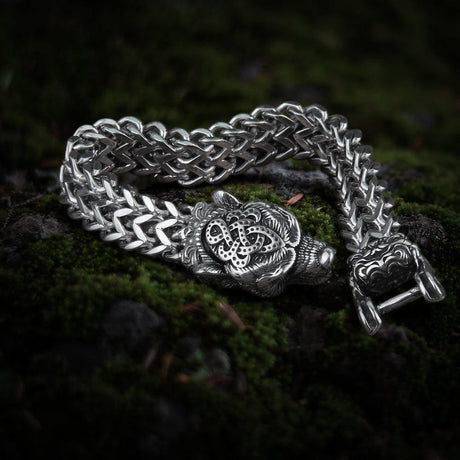
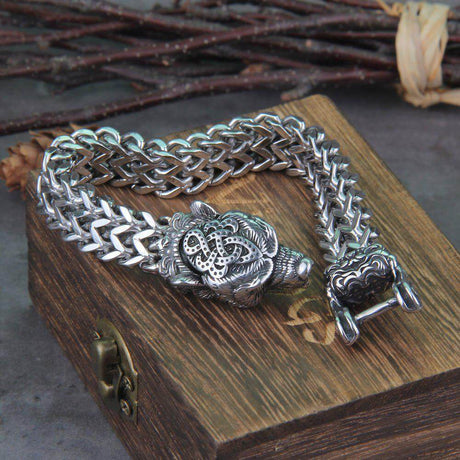
When searching for items inspired by The Fenrir Wolf, collectors look for specific traits that capture his raw energy:
- Gnarled Wood and Dark Steel: Materials that suggest a life lived in the wild and the strength to break iron.
- Intricate Knotwork: Traditional Jellinge or Ringerike art styles that depict wolves intertwined in combat.
- Runes of Power: Inscriptions that invoke the strength of the wolf or the protection of the old ways.
Why The Fenrir Wolf Axe is the Ultimate Collector's Piece
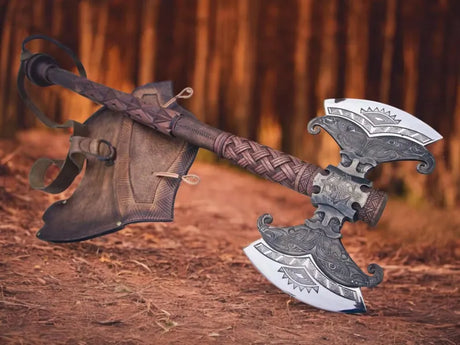
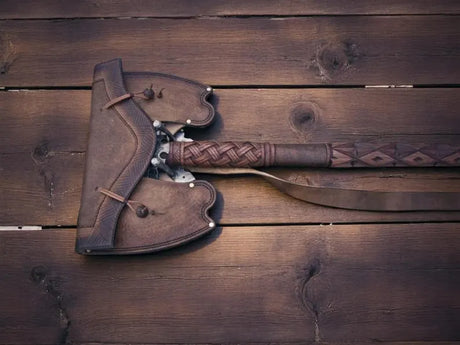
While jewelry like rings and necklaces are popular, nothing captures the "God-Slayer" energy quite like an axe. An axe represents the utility of the Viking age and the lethal power of the Great Wolf. It is a functional piece of art that bridges the gap between the ancient forge and the modern home.

The Fenrir Wolf Axe
Conclusion
The Fenrir Wolf is more than a myth; he is a testament to the fact that some spirits are simply too great to be contained. He teaches us that there is a time for binding and a time for breaking free. To carry the mark of Fenrir is to accept your own strength and to stand ready for whatever Ragnarök life throws your way.
Are you ready to wield the power of the wolf? Do not settle for a weapon that lacks a soul. Carry a piece of the prophecy with you.
Stand against the gods. Experience the raw power of the North and shop The Fenrir Wolf Axe at Tales of Valhalla today!