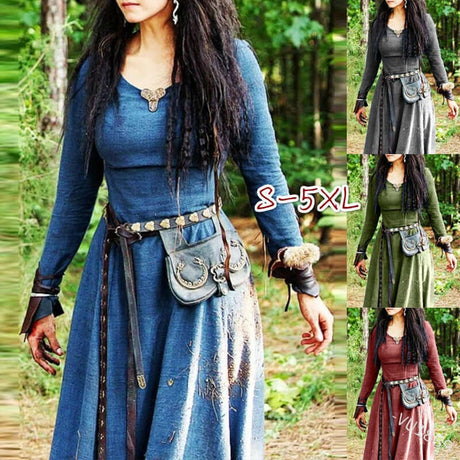
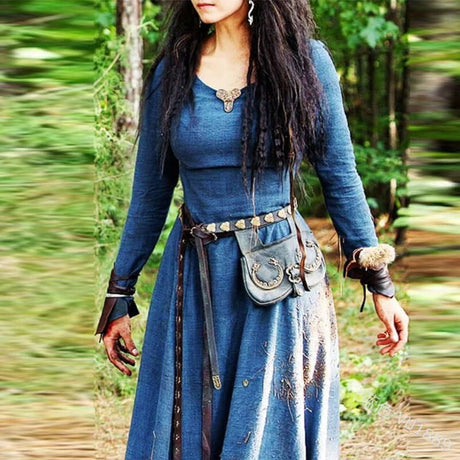
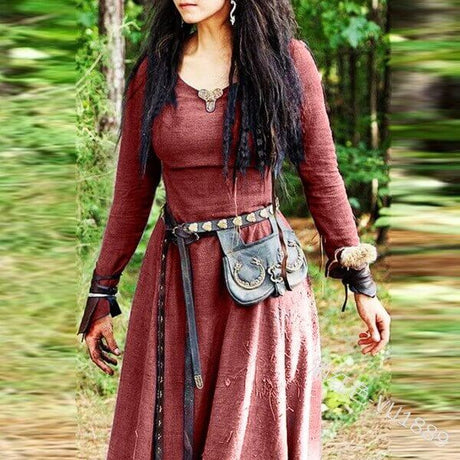
Imagine you are standing on the edge of a windswept fjord in the year 950 AD. The air is sharp with the scent of salt and roasting hearth-fire. Beside you, a woman moves with purpose, her silhouette defined by a garment that is as practical as it is striking. It isn't the tattered, mud-brown rag you see in modern television dramas. Instead, it is a vibrant, deep blue wool, held together by shimmering bronze brooches that catch the morning sun.
This iconic garment is the smokkr, better known to us today as the Viking Apron Dress.
For many history enthusiasts in the United States, the Viking Apron Dress represents more than just a costume. It is a portal into the lives of the women who managed the homesteads, traded in bustling markets like Birka, and navigated the complex social hierarchies of the Norse world. But what exactly makes a Viking Apron Dress authentic? How was it constructed, and why does its anatomy continue to baffle and fascinate archaeologists today?
In this comprehensive guide, we are going to perform a "deep-tissue" anatomy of the Viking Apron Dress. We will explore the layers beneath it, the hardware that secured it, and the cultural weight it carried across the North Atlantic.
Beyond the "Hangerock": What is a Viking Apron Dress?
To the untrained eye, the Viking Apron Dress looks like a simple over-garment, similar to a modern pinafore. However, within the world of experimental archaeology, it is one of the most debated pieces of clothing in human history.
The term smokkr or hangerock (hanging dress) refers to the outer layer worn by Norse women during the Viking Age (roughly 793–1066 AD). Unlike the tailored gowns of the Mediterranean, the Viking Apron Dress was a garment born of the loom’s limitations and the environment's demands. It was designed to provide warmth, display wealth through jewelry, and offer the wearer a range of motion necessary for everything from grinding grain to boarding a longship.

Beyond the "Hangerock": What is a Viking Apron Dress?
The Myth of the "One-Size-Fits-All"
When I first started attending historical reenactment events in the Midwest, I noticed a common trend: everyone wore the same "tube" style dress. But as research has progressed, we’ve learned that the Viking Apron Dress was highly individualized. Depending on whether a woman lived in what is now Denmark, Sweden, or Norway, her Viking Apron Dress might look vastly different in cut and color.
The Multi-Layered Mystery: Anatomy of the Norse Silhouette
You cannot understand the Viking Apron Dress without looking at what happened underneath it. A Viking woman’s outfit was a system of layers, each serving a specific biological and social function.
1. The Serk (The Under-Dress)
Before a woman even touched her Viking Apron Dress, she donned the serk. Usually made of bleached or natural linen, the serk was a long-sleeved, floor-length gown.
- Purpose: It acted as a sweat-wicking layer, protecting the expensive wool of the Viking Apron Dress from body oils.
- The "Pleated" Variant: In wealthy graves at Birka, Sweden, we find evidence of finely pleated linen serks. This wasn't just for fashion; pleating a dress required significantly more fabric, making it a "flex" of financial power.
2. The Viking Apron Dress (The Middle Layer)
Over the linen serk went the wool Viking Apron Dress. It was typically sleeveless and held up by two sets of straps.
- The Front Straps: Short loops of fabric.
- The Back Straps: Longer loops that came over the shoulders to meet the front loops.
3. The Kaftan or Cloak (The Outer Layer)
In the biting cold of a Scandinavian winter, the Viking Apron Dress wasn't enough. Women added wool kaftans—long jackets that buttoned or were pinned at the chest—or heavy wool cloaks. This ensemble created a silhouette that was bulky but incredibly efficient at trapping heat.
The Construction: How a Viking Apron Dress Was Actually Made
One of the biggest hurdles in reconstructing an authentic Viking Apron Dress is that fabric rots. Most of our knowledge comes from "loops"—small fragments of fabric preserved by the metal salts in the bronze brooches.
Tubular vs. Wrap-Around
Historians generally lean toward two primary theories of construction for the Viking Apron Dress:
- The Tubular Model: The dress is a closed cylinder, sometimes with gores (triangular inserts) added to the sides to create a "flare" at the bottom. This is the most popular style for modern hobbyists.
- The Wrap-Around Model: The dress consists of a single piece of fabric wrapped around the body, leaving an opening at the side or front. This model is supported by fragments found in Hedeby, where the fabric seems to have finished edges that don't meet.
The "Gore" Factor
To make the Viking Apron Dress comfortable for sitting or walking, weavers added triangular panels called gores. By inserting these into the side seams, the dress could remain snug at the chest (to hold the weight of the brooches) while flowing freely at the ankles.
Archaeological Reality vs. Hollywood Myth
To help you distinguish between a historically grounded Viking Apron Dress and a "Viking-themed" costume, let’s look at the data.
| Feature | Archaeological Evidence | Hollywood / TV Tropes |
| Material | 100% Wool or Linen | Leather, Polyester, Suede |
| Hardware | Oval (Turtle) Brooches | Buckles, Grommets, Zippers |
| Color | Woad (Blue), Madder (Red), Weld (Yellow) | All Black, All Brown, Distressed Grey |
| Fit | Layered and Functional | Tight-fitting, "Corset-style" |
| Hemline | Usually Floor or Ankle Length | Short or Asymmetrical |
| Decoration | Silk piping, Tablet-woven trim | Fur trim, Studs, Spikes |
Expert Quote: "The Viking Apron Dress was a social document. By looking at the thread count and the dye, we can tell if a woman was a farm hand or the wife of a chieftain. It wasn't just clothing; it was her status worn on her sleeve—or rather, her straps." — Dr. Ingvild Øye, Textile Historian
The Hardware: Why Brooches Are the Heart of the Viking Apron Dress
If the fabric is the body of the Viking Apron Dress, the brooches are its soul. Specifically, we are talking about Oval Brooches, often called "Turtle Brooches" because of their domed, shell-like shape.
The Role of the Turtle Brooch
In the Viking Age, these brooches were not just decorative; they were structural. They pinned the strap loops of the Viking Apron Dress together.
- Mass Production: These were among the first "mass-produced" items in Scandinavia. Metalworkers used clay molds to cast thousands of them, yet each region had slightly different artistic patterns.
- Pairing: You almost always see them in pairs. Finding a single oval brooch in a grave usually indicates that the other was lost or the burial was disturbed.
The Festoons (The Bling)
Between the two brooches, women often strung "festoons"—multiple strands of colorful glass beads, amber, and even silver coins.
- Tools on the Go: Hanging from the brooches or the bead strands, you would find a "chatelaine" of tools. This included a small knife, a whetstone, a needle case, and a pair of tweezers.
- Practicality: For a woman wearing a Viking Apron Dress, her jewelry was her toolbox. She carried the essentials of her daily life right on her chest.
The Colors of Status: Dyeing the Viking Apron Dress
One of the most evocative aspects of the Viking Apron Dress is its color. We often imagine the past in black and white, but the Viking world was a technicolor dream.
The Power of Blue
The most common color found in high-status Viking Apron Dress fragments is blue, derived from the woad plant. Because woad required a complex fermentation process, a deep, saturated blue was a sign of significant wealth.
The Madder Red
Red was another favorite, achieved through madder root. In the United States, we often associate red with "royalty," and in the Viking Age, this wasn't far from the truth. A vibrant red Viking Apron Dress would have stood out brilliantly against the white snow of a Northern winter.
Tablet-Woven Trim
The edges of a high-end Viking Apron Dress were rarely left plain. Women used a technique called tablet weaving to create intricate, narrow bands of fabric. These bands were sewn onto the top and bottom hems. Some were even woven with silver or gold wire, catching the light as the wearer moved.
Regional Variations: Birka, Hedeby, and Beyond
Not every Viking Apron Dress was created equal. As the Vikings traveled and traded, they adopted different styles.

Regional Variations: Birka, Hedeby, and Beyond
The Birka Style (Sweden)
Finds from the trading center of Birka suggest a very "bling-heavy" Viking Apron Dress. Here, we find the most evidence of silk trimmings and elaborate beadwork. The Birka woman was cosmopolitan, likely wearing silk imported from as far away as Byzantium on her Viking Apron Dress.
The Hedeby Style (Denmark)
In Hedeby, the fragments suggest a more tailored approach. Some researchers believe the Viking Apron Dress here may have featured darts or shaping to fit the body more closely, moving away from the "tube" shape toward something more sophisticated.
The Kostrup Find
A find in Kostrup, Denmark, gave us a rare glimpse at the straps. We discovered that some straps were made of the same wool as the Viking Apron Dress, while others were made of linen. This suggests that women were making conscious choices about comfort and durability.
-
You may also want to check out this product: Fairy Retro Dress
The "Hangerock" Debate: Addressing Alternative Perspectives
In any academic field, there are disagreements. The Viking Apron Dress is no exception. Some scholars argue that we have over-generalized the garment.
Was it Always Worn?
Some researchers suggest that the Viking Apron Dress was "formal wear." They argue that for daily chores around the farm, a woman might have just worn a simple tunic. The Viking Apron Dress, with its heavy bronze brooches and hanging tools, might have been the equivalent of a "Sunday best" or a status uniform for appearing in public.
The "Open Front" Theory
There is also a significant debate about whether the Viking Apron Dress was open in the front. Some suggest it was actually two separate panels of fabric—one in front and one in back—joined only by the brooches at the shoulders. While this would make the garment very adjustable (perfect for pregnancy!), it would be much less effective at keeping out the cold.
The American Obsession: Reclaiming the Viking Apron Dress
Why is a 1,000-year-old dress so popular in the United States today? From the rolling hills of Pennsylvania to the forests of the Pacific Northwest, the Viking Apron Dress has become a symbol of a "return to roots."
The Slow Fashion Movement
In an age of fast fashion and disposable clothing, making a Viking Apron Dress is an act of rebellion. It requires understanding the weight of wool, the texture of linen, and the patience of hand-sewing. For many Americans, donning a Viking Apron Dress at a festival or a living history event is a way to connect with a heritage that feels more "real" than the digital world.
Reenactment and LARP
Whether it’s the Society for Creative Anachronism (SCA) or Live Action Role Playing (LARP), the Viking Apron Dress is a staple. It is the perfect "entry-level" historical garment because it is forgiving to fit, but it offers an infinite ceiling for those who want to master embroidery and tablet weaving.
Building Your Own Viking Apron Dress: A Human-Centered Approach
If you are inspired to create your own Viking Apron Dress, don't let the archaeology intimidate you. History is a conversation, and your recreation is a part of it.
- Pick Your Fabric Wisely: Start with 100% wool. Avoid "mystery blends." A real Viking Apron Dress needs the breathability of natural fibers.
- The "Safety Pin" Test: Before you buy expensive turtle brooches, use large safety pins to figure out where you want your straps to sit. The brooches should rest just below your collarbone.
- Don't Skimp on the Serk: Remember, the linen under-dress is what makes the wool comfortable. If you skip the serk, you’ll be itching within an hour.
- Embrace the Imperfection: The original Viking Apron Dress was hand-sewn by candlelight. Your stitches don't need to be perfect; they just need to be strong.
The Weight of History: A Statistical Look at the Smokkr
To understand the physical experience of wearing a Viking Apron Dress, consider these average weights and measurements.
| Component | Average Weight / Length | Material |
| Linen Serk | 1.5 lbs | Linen (3-4 yards) |
| Wool Apron Dress | 2.5 lbs | Wool (2.5 yards) |
| Pair of Oval Brooches | 0.5 - 1.0 lbs | Bronze or Brass |
| Bead Festoons | 0.3 lbs | Glass, Amber, Silver |
| Total Outfit Weight | 5.0 - 7.0 lbs | All Natural Fibers |
Note: Carrying 6 pounds of clothing might seem heavy to us in the age of t-shirts, but for a Viking woman, this weight was a distributed, insulating shield against the elements.
Conclusion: The Legacy of the Viking Apron Dress
The anatomy of the Viking Apron Dress is a testament to a culture that valued durability, utility, and a very specific kind of beauty. It wasn't just a dress; it was a life-support system. It carried the tools of the hearth, the wealth of the family, and the warmth needed to survive the Viking Age.
When you look at a Viking Apron Dress now, I hope you see more than just fabric and bronze. I hope you see the woman who wove the wool by a flickering oil lamp. I hope you see the trader who bargained for those glass beads in a crowded stall. And I hope you see the timeless ingenuity of a design that, even a millennium later, still captures our imagination and echoes the tales of valhalla.
The Viking Apron Dress reminds us that we have always found ways to wrap ourselves in both protection and identity. It is a tradition that refuses to stay buried in the Viking graves of the past.
"Tales of Valhalla is an expert chronicler of the Viking Age, blending scholarly research with master storytelling to revive the Old North. From the hidden depths of Norse mythology to the tactical grit of the sagas, they provide authentic, rich insights into the warriors, leaders, and legends that forged history." - Specialist in Norse mythology and Viking history