Imagine you are standing on a frigid coastline in 8th century Scandinavia. The air is thick with the scent of salt and pine. In your hand, you grip a tool. It isn’t a gleaming, jewel encrusted sword of a king; it’s the same tool you used this morning to split logs for your hearth. But as the longship’s prow grinds against the shingle of a foreign shore, that tool transforms.
The Viking Fighting Axe is perhaps the most iconic weapon in human history, yet its origins are humble. Unlike the sword, which was a luxury item—the "Ferrari" of the Viking Age—the axe was the weapon of the people. It was a tool born of necessity, forged in the domestic sphere, and eventually perfected into a terrifying instrument of war.
In this deep dive, we will explore the engineering, the sociology, and the brutal effectiveness of the Viking Fighting Axe. We’ll see how a simple wood splitting implement evolved into the specialized "Dane Axe" that could cleave a horseman in two.
The Humble Origins: The Woodman’s Friend
In the early Viking Age, most Norsemen were not full time soldiers; they were farmers, smiths, and traders. Iron was expensive and difficult to produce. To own a sword required immense wealth, often equivalent to the price of several cows.
However, every household needed an axe. It was essential for clearing land, building ships, and providing fuel. When the "Viking" (a verb meaning to go on an expedition) call came, the farmer grabbed what he had.

The Humble Origins: The Woodman’s Friend
The Skeggøx or "Bearded Axe"
One of the first major evolutions from the tool to the weapon was the "Bearded Axe." If you look at a standard wood chopping axe, the blade is symmetrical. The Viking Fighting Axe, specifically the bearded variety, featured an elongated lower edge (the "beard").
- Utility: The beard allowed the user to grip the handle directly behind the blade for fine woodworking or shaving wood.
- Combat: In a fight, that same beard could be used to hook an opponent’s shield rim, pulling it down to expose their neck or torso for a follow up strike.
This dual purpose design is a masterclass in Viking pragmatism. Why carry two pieces of iron when one can build a house and win a feud?
Forged in Fire: The Metallurgy of Death
To understand the Viking Fighting Axe, we must look at the smithy. Viking blacksmiths were surprisingly advanced, using a technique called "laminated steel." They would forge a body of soft, flexible iron and weld a high carbon steel edge onto the bit.
This created a weapon that was:
- Durable: The soft iron absorbed the shock of impact without snapping.
- Lethal: The steel edge could be honed to a razor’s sharpness.
Comparison of Viking Weaponry Costs
| Weapon Type | Relative Cost | Primary User | Skill Level Required |
| Viking Fighting Axe | Low to Medium | General Infantry/Farmers | Moderate |
| Spear | Low | Common Levy | Low |
| Sword | Extremely High | Nobility/Jarls | High |
| Dane Axe | Medium | Specialized Shock Troops | Expert |
As the table shows, the Viking Fighting Axe sat in the "sweet spot" of being affordable yet devastatingly effective for the average warrior.
The Transition to a Specialized War Machine
As the Viking raids shifted from hit and run coastal strikes to full scale territorial conquests (like the Great Heathen Army’s invasion of England), the gear had to change. The Viking Fighting Axe began to shed its "homestead tool" skin.
By the 10th and 11th centuries, we see the rise of the Breid øx or the Broad Axe. This wasn’t for chopping wood. The blade became thinner and wider, sometimes reaching a foot across. This thinness made the axe lighter and faster, allowing for "snapping" cuts that could sever limbs with minimal effort.
The Psychology of the Axe
There is a unique psychological terror associated with an axe. A sword is a weapon of finesse—a thrust, a parry. An axe is a weapon of momentum. When a 250 pound Norseman swings a Viking Fighting Axe, the kinetic energy concentrated on that narrow edge is astronomical.
Dr. Jan Petersen, whose typology of Viking weapons remains the gold standard for historians, noted that as the era progressed, axe heads became more specialized. They weren’t just "axes" anymore; they were carefully balanced machines designed to bypass the mail armor that was becoming more common in Europe.
The "Great Axe" of the North: The Dane Axe
If the bearded axe was the versatile sidearm, the Dane Axe was the heavy artillery. Often featuring a shaft four to six feet long, this version of the Viking Fighting Axe required two hands to wield.
Historical accounts from the Battle of Hastings (1066) describe the Anglo Saxon Housecarls (who used Viking style axes) standing in their shield wall. A single swing of a Dane Axe was recorded to have decapitated horses and cleaved through heavy shields and the men behind them.
"The Viking does not strike to wound; he strikes to end the conversation." — Common historical sentiment regarding Norse combat.
Strategic Limitations and Strengths
While the two handed Viking Fighting Axe was powerful, it came with a risk: you couldn’t carry a shield. This forced a change in tactics. Axe wielders would often stand behind the first rank of the shield wall, reaching over their comrades’ shoulders to deliver crushing blows, or they would step out during a lull to "break" the enemy’s formation.
Anatomy of a Legend: What Made It So Good?
Let’s break down the physical characteristics that made the Viking Fighting Axe a dominant force for nearly 300 years.
- The Haft (Handle): Usually made of ash or oak, the wood was chosen for its straight grain and ability to flex.
- The Eye: The hole where the handle meets the head. Viking smiths often made this teardrop shaped to prevent the head from spinning on the shaft.
- The Weight: Contrary to popular belief (and Hollywood movies), a Viking Fighting Axe was not a heavy, clunky "executioner’s axe." Most weighed between 1 and 2 pounds. They were lightning fast.
Stat Check: The Impact of the Axe
- Average Weight of Head: 0.5kg to 0.8kg (1.1 to 1.7 lbs)
- Effective Reach: 24 to 36 inches (One handed) / 50 to 60 inches (Two handed)
- Impact Force: Capable of generating over 1,000 Newtons of force in a standard swing.
Addressing the Myths: Did They Really Use Double Bit Axes?
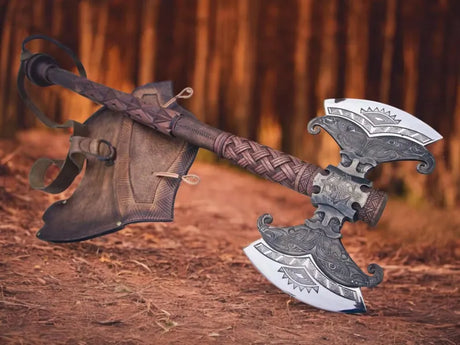
If you go to a Renaissance Fair or watch a fantasy movie, you’ll see Vikings carrying massive, double bladed axes. This is a total myth.

Addressing the Myths: Did They Really Use Double Bit Axes?
Archaeological records across Scandinavia, from the burial mounds of Norway to the riverbeds of England, have yielded thousands of axe heads. Virtually none of them are double bitted. Why? Because a double bitted axe is:
- Too Heavy: It slows you down in a life or death duel.
- Dangerous: You can’t "choke up" on the blade or use it for hooking without risking injury to yourself from the rear blade.
- Wasteful: It requires twice the precious steel for no added tactical benefit.
The true Viking Fighting Axe was a lean, mean, single bladed tool of efficiency.
The Cultural Soul of the Axe
To the Vikings, the axe was more than iron and wood. It was a symbol of their status as free men. In the Hávamál (The Sayings of the High One), Odin advises men to never move a step away from their weapons.
The axe was a constant companion. It sat by the door at night and leaned against the bench during the feast. We see this reflected in the names they gave their weapons. A warrior might name his Viking Fighting Axe "Brain Biter," "Shield Wall Widow Maker," or "Wound Hoe." This personification shows an intimate bond between the man and his tool of survival.
- See more: Viking Fighting Axe
Real Life Example: The Battle at Stamford Bridge
In 1066, a lone Viking supposedly held the entire English army at bay on a narrow bridge. Armed with a massive Viking Fighting Axe, he cut down 40 men before someone floated under the bridge in a barrel and thrust a spear through the floorboards. Whether the number is exaggerated or not, the fact that an axe was the chosen weapon for a "one vs army" stand speaks volumes about its defensive and offensive capabilities.
How the Axe Shaped Modern History
We often think of the Viking Age ending, but the Viking Fighting Axe lived on. It evolved into the halberd and the poleaxe of the Middle Ages. Even the "Tomahawk" used in the early Americas shares a spiritual and functional lineage with the small Norse hand axe.
For modern enthusiasts in the United States, the fascination with the Viking Fighting Axe isn’t just about violence; it’s about the connection to a "DIY" culture. The idea that a man could take a tool from his daily life and, through skill and courage, change the course of history is a powerful narrative that resonates with the American spirit of self reliance.
Practicality vs. Prestige: A Nuanced View
While I have championed the axe as the ultimate weapon, we must acknowledge its limitations. A sword is better for thrusting in tight quarters. A spear has a longer reach.
However, the Viking Fighting Axe won the "popularity contest" because of its versatility. If your spear shaft breaks, you have a stick. If your Viking Fighting Axe shaft breaks, you can re haft it at the next campfire. If your sword gets notched, it’s a disaster. If your axe gets a chip, you grind it out and keep chopping.
Maintenance and Longevity
| Feature | Viking Axe | Medieval Sword |
| Field Repair | Easy (New wood shaft) | Impossible (Requires Forge) |
| Versatility | High (Weapon & Tool) | Low (Weapon only) |
| Armor Penetration | Excellent (Concentrated force) | Poor (Requires gaps in armor) |
| Weight Distribution | Top heavy (Good for power) | Balanced (Good for speed) |
Conclusion: The Legacy of the North
The journey of the Viking Fighting Axe is a testament to human ingenuity. It proves that greatness doesn’t always come from the most expensive materials, but from the most effective application of what you have. From the smoke filled longhouses of the fjords to the bloody fields of Hastings, this weapon carved out the borders of modern Europe.
Whether you are a historian, a martial artist, or someone who just appreciates the fine balance of a well made tool, the Viking Fighting Axe stands as a pinnacle of functional design. It reminds us that every masterpiece of war likely started as a humble tool of the home.
As we look back at these warriors and their iron companions, we don’t just see a history of raiding; we see the tales of valhalla etched into every notched blade and weathered handle. The axe was the key that opened the doors of the world for the Norsemen, and its echo still rings in our culture today.
"Tales of Valhalla is an expert chronicler of the Viking Age, blending scholarly research with master storytelling to revive the Old North. From the hidden depths of Norse mythology to the tactical grit of the sagas, they provide authentic, rich insights into the warriors, leaders, and legends that forged history." - Specialist in Norse mythology and Viking history