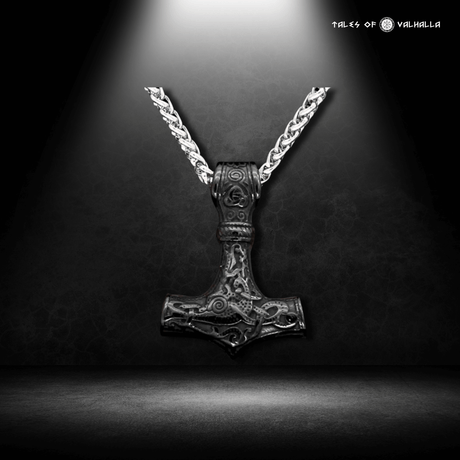
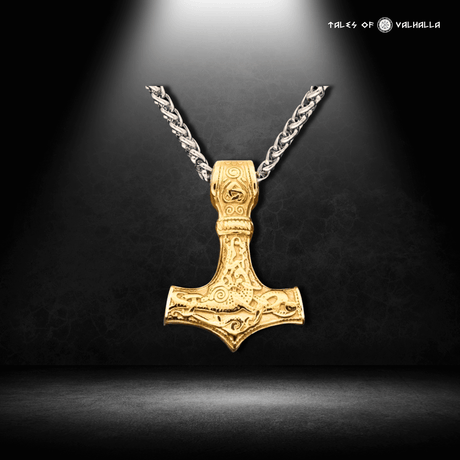
Imagine walking through a grand historical exhibit in Chicago or New York. The room is dimly lit to protect the ancient artifacts. A single spotlight shines down on a tiny silver brooch inside a glass case. As you lean in closer, you realize this is not just an old piece of metal. It is a breathtaking piece of Viking Art. The surface is covered in twisting animals and endless knots. This tiny object holds the soul of an entire civilization.
When most people in the United States think of the ancient Norsemen, they picture fierce warriors. They imagine massive wooden ships crashing through icy waves. They visualize heavy swords and thick shields. However, there is a completely different side to this fascinating culture. Viking Art proves that these people were also master craftsmen. Their artistic vision was incredibly complex. The evolution of Viking Art spans over three centuries. It transformed dramatically as the Norse people explored the world.
Today, we will take a deep dive into the evolution of Viking Art. We will embark on a journey through the distinct Norse styles. We will explore how this art reflects a rapidly changing society. By the end of this exploration, your view of the ancient North will be forever changed.
Breaking the Stereotype: The True Nature of Viking Art
A very common myth exists in modern pop culture. Many people believe the Norse were nothing more than savage raiders. They assume these people had no time for beauty or creativity. This is a very limited and inaccurate viewpoint. When you actively study Viking Art, a completely different picture emerges.

Viking Art
Viking Art is deeply intricate. It is profoundly connected to nature, mythology, and the human experience. The creators of Viking Art were highly skilled professionals. They dedicated their entire lives to perfecting their craft. Furthermore, they did not just paint pictures on flat walls like other ancient cultures. They carved their art directly into their daily lives.
Swords, hair combs, wooden ships, and daily jewelry all featured stunning Viking Art. They believed that everyday objects should be beautiful. An expert in Norse history, Dr. Arvid Henriksson, frequently discusses this topic. He states that Viking Art is the true visual language of the Norse soul. He notes that through their intricate carvings, they communicated their deepest religious beliefs. This makes Viking Art a vital tool for understanding their ancient world.
The Dawn of Norse Creativity: Oseberg and Broa Styles
The incredible journey of Viking Art begins in the late eighth century. This was a time before the massive global expansions. The early Norse tribes were establishing their identities.
The Chaotic Beauty of the Oseberg Style
The Oseberg style is one of the earliest known forms of Viking Art. It gets its famous name from a massive ship burial discovered in Norway. When archaeologists unearthed this ship, they found a treasure trove of early Viking Art.
If you look closely at Oseberg Viking Art, you will quickly notice the famous gripping beast motif. This artistic creature is wild, aggressive, and chaotic. It has bulging eyes and thick paws. The beast actively grabs onto its own body. It grabs onto the borders of the carving. It grabs onto neighboring animals.
This style of Viking Art represents the unpredictable nature of the ancient world. Life was incredibly harsh, and the art reflects that struggle. The gripping beast shows a world filled with untamed energy.
The Transition to the Broa Style
As Viking Art progressed over the decades, it slowly moved into the Broa style. This phase of Viking Art is slightly more structured than the Oseberg era. The carved lines became much more fluid and intentional.
Artists started experimenting with different animal shapes and smoother curves. It is almost like watching a talented child learn to master a pencil, but on a masterful, societal level. The craftsmen began to understand how to use negative space. This early era of Viking Art laid the absolute foundation for everything that followed.
The Golden Age of Viking Art: Borre, Jelling, and Mammen Styles
As the Norse people began to travel more extensively, Viking Art changed rapidly. They sailed across the treacherous oceans. They saw completely new lands. They met diverse new people and encountered foreign religions. These worldly experiences heavily influenced the next phases of Viking Art.
The Durable Borre Style
The Borre style of Viking Art emerged in the middle of the ninth century. This style introduced strict geometric patterns to the Norse world. When you examine Borre art, you see tightly interlaced knots. These knots form perfect squares and triangles.
The famous gripping beast is still present in Borre Viking Art, but it looks different. It is much more muscular and compact. It looks like a strong cat tightly gripping a rigid wooden frame.
This specific phase of Viking Art is incredibly durable and widespread. Archaeologists find Borre style Viking Art all over Europe and Russia. This widespread distribution proves exactly how far the Norsemen traveled and traded.
The Elegant Jelling Style
Next came the highly distinct Jelling style of Viking Art. This style takes its name from a royal burial site in Denmark. Animals in Jelling Viking Art look completely different from earlier beasts. They look like long, thin ribbons.
These animals have a pronounced S shape. They gracefully interlace with each other in a beautiful, endless dance. The Jelling style shows Viking Art becoming significantly more elegant. It feels much less chaotic and aggressive than the early gripping beasts. The artists were clearly aiming for visual harmony and balance.
The Magnificent Mammen Style
The Mammen style of Viking Art is where Norse creativity gets truly magnificent. The carved lines are noticeably thicker and heavier. The animals have intricate dots and complex patterns carved directly inside their bodies.
During the Mammen era of Viking Art, you also start seeing prominent plant motifs. The Norse people borrowed these leafy plant designs from their European neighbors. This proves a vital point about Viking Art. It was not an isolated practice. It was a living, breathing tradition that eagerly absorbed new ideas from the outside world.
Analyzing the Artifacts: A Data Perspective
To truly grasp the scope of this evolution, we must look at the archaeological data. Researchers have cataloged thousands of pieces of Viking Art across the globe. The distribution of these artifacts tells a fascinating story about trade routes and cultural peaks.
Here is a breakdown of how Viking Art artifacts are distributed by historical style based on archaeological estimates.
| Style Name | Approximate Era | Key Visual Characteristics | Estimated Percentage of Found Artifacts |
| Oseberg | 750 to 825 AD | Gripping beasts and chaotic interlacing | 15 percent |
| Borre | 850 to 950 AD | Geometric knots and muscular animals | 30 percent |
| Jelling | 900 to 975 AD | Ribbon animals and graceful S shapes | 20 percent |
| Mammen | 960 to 1020 AD | Thick lines and foreign plant motifs | 15 percent |
| Ringerike | 1000 to 1075 AD | Elongated crosses and almond shaped eyes | 10 percent |
| Urnes | 1050 to 1125 AD | Graceful loops and extreme elegance | 10 percent |
This table clearly highlights that the Borre and Jelling styles make up half of the discovered Viking Art. This massive volume perfectly correlates with the absolute peak of their global expansion and trade dominance.
The Final Flourish: Ringerike and Urnes Styles
The evolution of Viking Art did not stop with the Mammen style. As the society became more centralized and wealthy, the art reached entirely new heights of sophistication.

Ringerike and Urnes Styles
The Explosive Ringerike Style
In the early eleventh century, Viking Art transitioned into the beautiful Ringerike style. This style of Viking Art is incredibly famous for its distinct almond shaped eyes on all animal figures.
The central animals are constantly surrounded by explosive plant tendrils. When you look at this Viking Art, it looks as if the animals are running through a dense, windy forest. The energy is dynamic and directional.
This specific era of Viking Art is frequently found on large stone monuments called runestones. These massive stones were public monuments dedicated to the dead. The Viking Art carved into these stones served to honor their ancestors visually for the entire community to see.
The Pinnacle of Elegance: The Urnes Style
The final historical phase of Viking Art is the majestic Urnes style. Many modern art historians consider the Urnes style to be the absolute pinnacle of Viking Art.
The carved lines in Urnes Viking Art are incredibly thin, graceful, and smooth. The animals loop around each other in perfectly balanced figure eights. It is breathtakingly beautiful and requires immense skill to execute. The artists stripped away all the heavy blockiness of the past.
When you look at Urnes Viking Art, you are seeing the final, perfect expression of a culture. Shortly after this majestic period, the Christian religion completely took over Scandinavia. As a direct result, the traditional pagan Viking Art began to slowly fade into history.
Counterarguments and Alternative Perspectives
To understand this subject comprehensively, we must actively weigh contrasting viewpoints. Some cultural purists fiercely argue that Viking Art is completely unique to Scandinavia. They claim it developed entirely on its own without outside help.
However, modern research shows this is a deeply flawed perspective. We must look at alternative viewpoints to find the historical truth. Viking Art actually borrowed heavily from Celtic and Anglo Saxon designs.
When the Norsemen visited the British Isles, they did not just take silver and slaves. They took brilliant artistic ideas back home with them. Let us consider a hypothetical scenario. What if the Norse people never invented their famous longships? What if they never left their icy shores?
If that had happened, Viking Art would look completely different today. It would likely be much simpler and highly repetitive. The isolation would have completely starved the artists of new inspiration.
Acknowledging this heavy outside influence does not diminish the beauty of Viking Art. Instead, it highlights the ancient Norse people as brilliant cultural adapters. They took foreign visual concepts and totally transformed them into distinct, original Viking Art. They were innovators just as much as they were warriors.
The Materials Behind the Masterpieces
Understanding Viking Art requires looking at the materials the craftsmen used. They did not have access to modern tools or synthetic paints. They had to rely entirely on the natural world around them.
Wood was the most common canvas for Viking Art. The forests of Scandinavia provided endless supplies of timber. Craftsmen carved Viking Art into the massive wooden prows of their ships. They carved it into the wooden beams of their grand mead halls. Unfortunately, wood rots over time. This means thousands of pieces of wooden Viking Art have been lost forever to the damp earth.
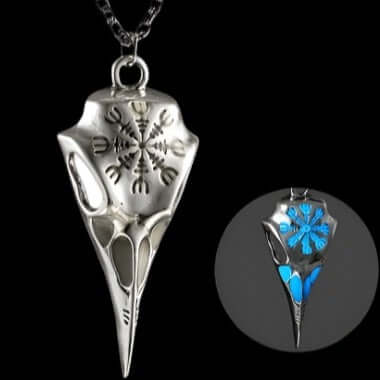
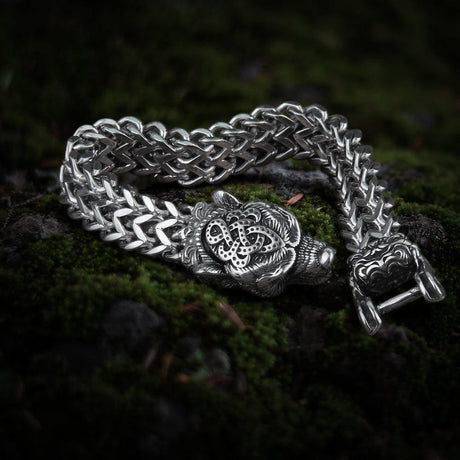
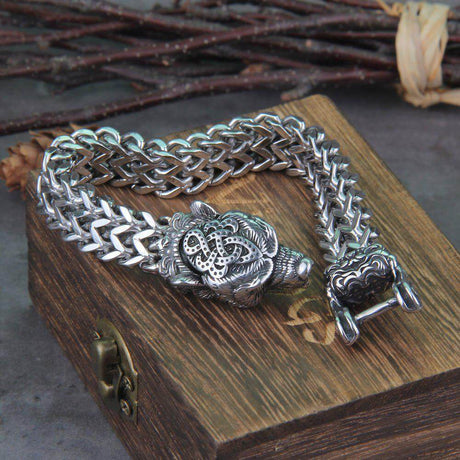
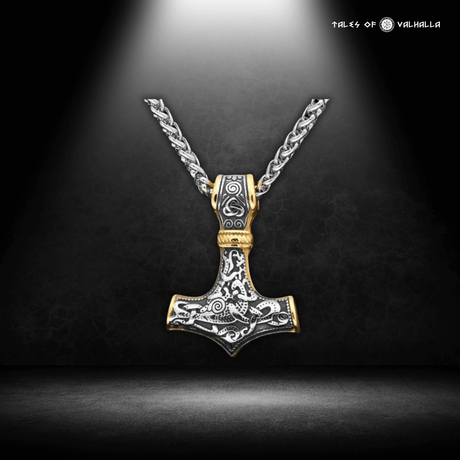
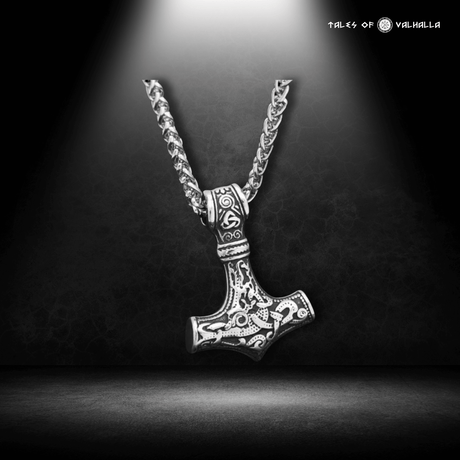
Metalwork is where Viking Art truly survived for us to see today. Blacksmiths and silversmiths were highly respected members of society. They cast molten silver and gold into intricate molds to create Viking Art jewelry. These metal pieces were often worn as a display of immense wealth and power.
Bone and walrus ivory were also popular mediums for Viking Art. Hunters would bring back tusks from the icy northern seas. Master carvers would then spend weeks etching tiny, perfect details into the hard ivory. These smaller pieces of Viking Art were often used as gaming pieces or clothing pins.
- May you like: Celtic Double Headed Axe
Viking Art in the Modern United States
You might be wondering why Viking Art matters to people living in the United States today. The answer is highly visible all around us in our modern culture.
Millions of Americans have Scandinavian ancestry. Many people discover these deep roots through modern DNA testing kits. Once they discover this genetic link, they actively seek out Viking Art to visually connect with their heritage.
You can clearly see Viking Art in modern American tattoo parlors. Every single day, Americans choose to ink their bodies with the ancient gripping beasts of Viking Art. They choose these designs because the art represents untamed strength and human resilience.
You also see Viking Art in massive Hollywood movies and popular streaming television shows. The massive boom in Norse mythology pop culture has brought Viking Art directly into American living rooms.
Modern metalworkers and independent woodcarvers across the United States continuously study and recreate Viking Art. They host workshops to teach the old techniques to new generations. When a modern American wears a handmade piece of jewelry featuring Viking Art, they are building a bridge across time. They are firmly connecting with ancient history. This widespread adoption proves that the aesthetic appeal of Viking Art is truly timeless.
The Enduring Legacy of Norse Craftsmanship
Viking Art is clearly not just a dusty relic of the ancient past. It is a highly transparent window into a very complex, emotional society. Through the careful study of Viking Art, we begin to truly understand their fears, their extensive travels, and their societal evolution.
We can visually trace their incredible journey from chaotic, isolated tribal factions to globally connected maritime traders. Every single surviving piece of Viking Art tells a human story.
From the heavy, aggressive wood carvings of the Oseberg ship to the impossibly delicate silver loops of the Urnes style, Viking Art speaks directly to the universal human desire to create lasting beauty. They wanted to leave a permanent mark on a world that was often dark, cold, and unforgiving.
As we continue to unearth new artifacts, our understanding of Viking Art will only grow deeper. Future archaeological digs will undoubtedly reveal new variations and unexpected foreign influences. The artists who carved these magnificent beasts and intricate knots are long gone from this earth. However, their artistic legacy will forever echo alongside the great tales of valhalla.