Imagine the sky turning a bruised shade of purple. The air grows heavy, thick with the scent of ozone and the static charge that makes the hair on your arms stand up. In the distance, a crack of sound so loud it feels like the earth itself is splitting open. To us, it’s a meteorological event. To a Viking, it was the sound of Thor’s Hammer meeting the skull of a frost giant.
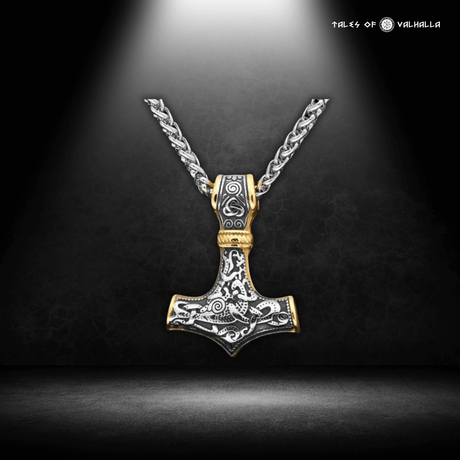
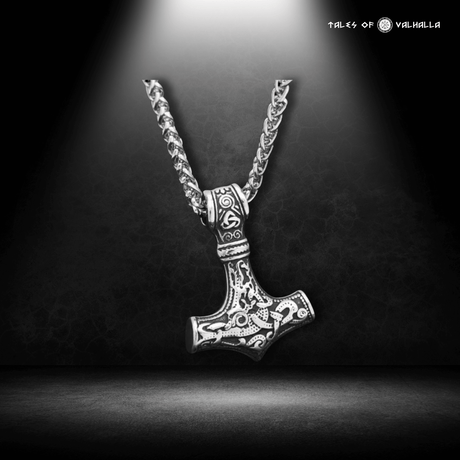
Thor’s Hammer, known as Mjolnir, is perhaps the most iconic weapon in human history. It isn't just a piece of iron; it is a symbol of protection, a tool of consecration, and the primary defense of Asgard against the forces of chaos. In the United States today, we see this symbol everywhere—from Marvel blockbusters to tattoos and jewelry—but the true story of Mjolnir goes far deeper than a cinematic special effect.
In this exhaustive 2,500-word exploration, we will dive into the celestial forge where Thor’s Hammer was born, analyze its dual nature as both a weapon and a ritual object, and look at the archaeological evidence that proves just how much this symbol meant to the people of the Viking Age.
The Birth of a Legend: How Thor’s Hammer Was Forged
Every great hero needs an origin story, but the origin of Thor’s Hammer is actually a story about Loki’s silver tongue and a very high-stakes bet.

The Birth of a Legend: How Thor’s Hammer Was Forged
The Wager of the Gods
The story begins with Loki, the trickster god, cutting off the beautiful golden hair of Sif, Thor’s wife, as a malicious prank. To avoid a literal bone-shattering beating from Thor, Loki promised to travel to Svartalfheim, the realm of the dwarves, to have them craft new hair made of real gold that would grow like natural hair.
While there, Loki decided to stir up more trouble. He bet his own head that two dwarf brothers, Brokkr and Sindri, could not create three items more magnificent than those already made by the Sons of Ivaldi. The brothers took the challenge.
The Forge and the Fly
As Sindri worked at the forge, he placed a piece of iron in the fire and told Brokkr to blow the bellows without stopping. Loki, fearing for his head, transformed into a biting fly to distract them.
- The first item: A golden boar (Gullinbursti).
- The second item: A golden ring (Draupnir).
- The third item: This was the masterpiece.
Loki bit Brokkr right on the eyelid, causing blood to run into his eye. For just a split second, Brokkr stopped pumping the bellows to wipe the blood away. When Sindri pulled the finished product from the forge, it was Thor’s Hammer. Because of that momentary pause in the bellows, the handle was slightly too short.
The Perfection of Imperfection
Despite the short handle, the gods judged Thor’s Hammer to be the greatest gift. Why? Because Sindri had imbued it with magical properties that made it the ultimate weapon. It would never break, it would never miss its mark, and if thrown, it would always return to the hand of the wielder. In a world where your weapon failing you meant death, Thor’s Hammer was the ultimate insurance policy.
More Than a Weapon: The Functions of Mjolnir
In modern pop culture, we primarily see Thor’s Hammer as something used to smash things. While it was certainly effective at pulverizing the enemies of the gods, its role in Norse society was far more nuanced.
The Protector of Midgard
Thor was the god of the common man—the farmers and the sailors. While Odin was the god of kings and poets, Thor was the one you called when you needed protection. Thor’s Hammer was the physical manifestation of that protection. By swinging the hammer, Thor kept the Jotnar (giants) at bay, ensuring that the human world, Midgard, remained safe from the primordial forces of destruction.
A Tool of Consecration
One of the most unique aspects of Thor’s Hammer was its use in rituals. It wasn't just for killing; it was for "hallowing" or making things holy.
- Weddings: In the poem Thrymskvitha, the hammer is placed in the lap of the "bride" (who was actually Thor in disguise) to bless the union.
- Births and Deaths: Thor’s Hammer was used to bless newborns and to sanctify funeral pyres.
I remember talking to a historian at a museum in Scandinavia who pointed out that the hammer was effectively a "divine stamp of approval." If you wanted a boundary to be respected or a contract to be binding, you invoked the power of Thor’s Hammer.
Archaeological Evidence: A Symbol Worn by Thousands
We don't just have to rely on myths to understand the importance of this symbol. The earth itself has provided us with thousands of examples of how the Vikings viewed Thor’s Hammer.
The Mjolnir Pendants
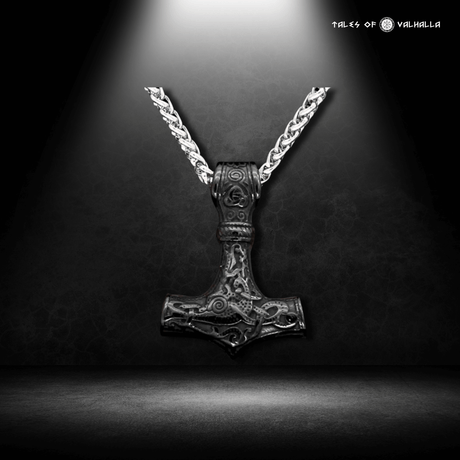
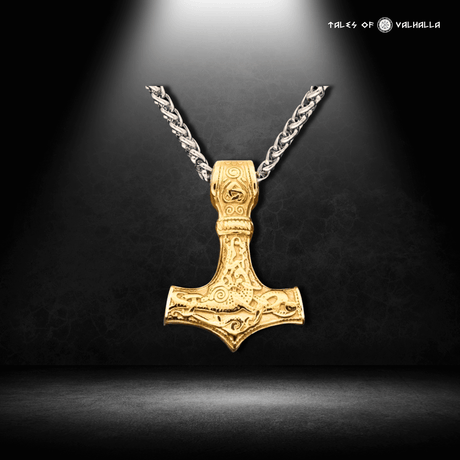
Archaeologists have discovered over 1,000 "Thor's Hammer" amulets across Northern Europe, dating from the 9th to the 11th centuries. These were the Viking version of a crucifix. People wore them as protective charms, signaling their devotion to the god of thunder.
Interestingly, as Christianity began to spread into the Viking world, we see a fascinating "religious competition" in the jewelry. Some molds have been found that could cast both a Christian cross and Thor’s Hammer at the same time. It seems the Viking craftsmen were covering all their bases for their diverse clientele.
Data on Historical Finds
The following table illustrates the distribution of these finds and what they tell us about the cultural reach of Thor’s Hammer.
| Region | Number of Amulets Found | Primary Material | Significance |
| Denmark | ~200+ | Silver / Bronze | Stronghold of Thor worship. |
| Sweden | ~400+ | Iron / Silver | Most concentrated area for amulets. |
| Iceland | ~10-20 | Stone / Silver | Unique "Wolf Cross" variants found here. |
| United Kingdom | ~50+ | Lead / Bronze | Evidence of Viking settlement and blending. |
| United States | Limited (Museums) | Replicas/Historical | High interest in Norse heritage and DNA. |
Expert Quote: "The Thor’s Hammer pendant was not just jewelry; it was a defiant statement of identity during a time when traditional Norse beliefs were being challenged by a new southern religion." — Dr. Arni Björnsson, Folklorist
The Tools of the Trade: Wielding the Hammer
Even for a god as strong as Thor, Thor’s Hammer wasn't easy to handle. To use Mjolnir to its full potential, Thor required two other magical items that are often overlooked in the movies.

The Tools of the Trade: Wielding the Hammer
1. Járngreipr (Iron Gloves)
Because the handle of Thor’s Hammer was shortened by Loki’s interference, it was difficult to grip during the intense heat of battle. Thor wore iron gloves to ensure his grip never slipped and to protect his hands from the sheer power radiating from the weapon.
2. Megingjörð (Power Belt)
This belt doubled Thor’s already legendary strength. When you are swinging a hammer made of celestial iron that has the power to shatter mountains, you need all the core strength you can get. Thor’s Hammer was the "bullet," but the belt and gloves were the "gun" that made it functional.
-
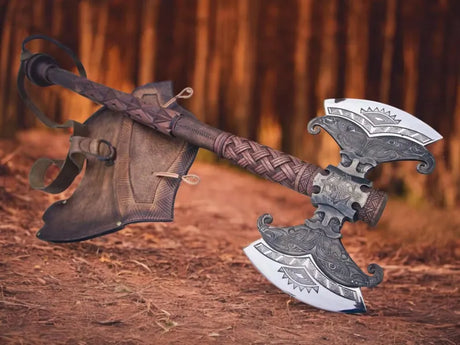
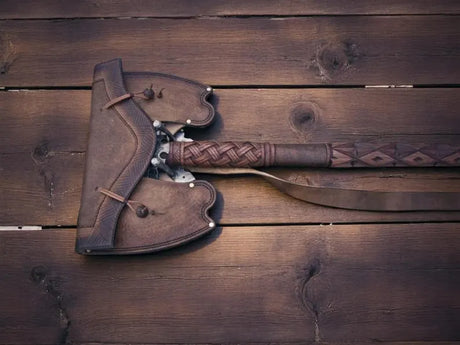
You might be interested in this product: Thor Engraved Axe
📜 The Myth of the Stolen Hammer: Thrymskvitha
To understand the character of Thor and the value of Thor’s Hammer, we have to look at the time he actually lost it. This story, found in the Poetic Edda, is one of the most famous and humorous in Norse mythology.
The Theft
Thor wakes up one morning to find his bed empty. Thor’s Hammer is gone. For Thor, this isn't just a lost tool; it’s a national security crisis. Without the hammer, Asgard is vulnerable. Loki discovers that the giant Thrym has stolen it and buried it eight miles deep in the earth. Thrym’s price for its return? The hand of the goddess Freyja in marriage.
The "Wedding"
Freyja, understandably, refuses. Heimdall, the ever-vigilant watchman, suggests a hilarious plan: Thor should dress up as the bride. He puts on a dress, a veil, and the famous necklace Brísingamen. Loki dresses as his bridesmaid.
When they arrive at the giant’s hall, Thor nearly blows his cover by eating an entire ox, eight salmon, and drinking three barrels of mead. Loki quickly explains that "the bride" hasn't eaten for eight days because she was so excited for the wedding.
The Restoration
Finally, Thrym calls for Thor’s Hammer to be brought out to sanctify the marriage. As soon as the hammer is placed in Thor’s lap, he grips the handle, tears off his veil, and proceeds to kill every giant in the room. This myth reinforces the idea that Thor’s Hammer is the only thing standing between civilization and the giants.
The Final Climax: Thor’s Hammer and Jörmungandr
The ultimate destiny of Thor’s Hammer is tied to Ragnarök—the end of the world. Thor’s greatest enemy is Jörmungandr, the Midgard Serpent, a creature so large it circles the entire world and bites its own tail.
Throughout the myths, Thor tries to kill the serpent with Thor’s Hammer multiple times. In one famous fishing trip, he almost pulls the serpent out of the water, but his companion cuts the line out of fear.
At Ragnarök, they finally meet for the last time. Thor will swing Thor’s Hammer and successfully crush the serpent's head, ending the threat forever. However, the serpent’s venom will be so potent that Thor will only take nine steps before falling dead himself. It’s a powerful metaphor: even the greatest protector can only defend the world by sacrificing himself.
Thor’s Hammer in Modern American Culture
Why is a 1,000-year-old hammer so popular in the United States today? The answer lies in our fascination with the "Self-Reliant Hero."
The Marvel Influence
We cannot discuss Thor’s Hammer without acknowledging the Marvel Cinematic Universe. While the movies take many liberties—like the idea that only the "worthy" can lift it (in the myths, you just had to be incredibly strong)—they have kept the spirit of the hammer alive. It represents the idea that power must be coupled with responsibility.
Identity and Heritage
For many in the US with Scandinavian roots, wearing Thor’s Hammer is a way to reconnect with their ancestry. It’s a piece of "wearable history" that connects the modern world to a time when people lived in closer harmony with the raw power of nature.
The Misuse of the Symbol
It is important to address a sensitive counterargument. In recent years, some extremist groups have tried to co-opt Thor’s Hammer as a symbol of white supremacy. However, historians and practitioners of modern Heathenry are quick to point out that Thor’s Hammer was historically a symbol of protection for all people. The Vikings were global travelers who traded from North America to Constantinople. Reclaiming Thor’s Hammer from these fringe groups is a major focus for many modern Norse scholars.
Scientific Perspective: What Was it Made Of?
While the myths say it was made of iron from the "dwarven forges," modern science offers a different, equally cool theory.
Meteoritic Iron
Some historians speculate that the inspiration for magical weapons like Thor’s Hammer may have come from meteoritic iron. Before humans learned to smelt iron from ore, they occasionally found iron that literally fell from the sky. This iron was purer and stronger than anything else available.
Imagine finding a metal that fell during a thunderstorm. It’s easy to see how a primitive culture would conclude that this metal was a gift from the thunder god himself. The "celestial iron" of Thor’s Hammer might be more than just a myth; it might be a memory of the first iron age.
Comparison: Mjolnir vs. Other Mythic Weapons
How does Thor’s Hammer stack up against other legendary gear? Let's look at the stats.
| Weapon | Origin | Primary Power | Limitation |
| Thor’s Hammer | Norse | Infinite damage, returns when thrown. | Needs iron gloves and belt. |
| Gungnir (Odin’s Spear) | Norse | Never misses its target. | Lacks the sheer crushing power of Mjolnir. |
| Excalibur | Arthurian | Grants sovereignty and healing. | Only as strong as the King’s virtue. |
| Aegis (Athena’s Shield) | Greek | Induces terror in enemies. | Primarily defensive. |
As we can see, Thor’s Hammer is the most versatile. It is a boomerang, a sledgehammer, a holy relic, and a lightning rod all in one.
Real-Life Application: The "Hammer" Mentality
What can we learn from Thor’s Hammer today? Even if you don't believe in thunder gods, the symbolism of Mjolnir offers some profound life lessons.
- Preparation is Key: Thor couldn't use the hammer effectively without his gloves and belt. In life, your talent (the hammer) is useless if you don't have the discipline (the belt) to wield it.
- Protect the Vulnerable: Thor didn't use the hammer to conquer; he used it to defend. The "Hammer Mentality" is about using your strength to build a fence around those who can't protect themselves.
- Accept Imperfection: Thor’s Hammer had a short handle because of a fly bite. It was "broken" from the start, yet it became the most powerful weapon in the universe. Our flaws don't disqualify us from being great; they often make our story more compelling.
Conclusion: The Echo of the Hammer
Thor’s Hammer is more than a relic; it is a living force. Every lightning bolt and roll of thunder is the natural phenomenon that birthed one of history's most enduring Tales of Valhalla. Mjölnir stands as a symbol of human resilience, reminding us that no matter the size of the giants or the darkness of the storm, we possess the tools to stand our ground.
Whether worn as a tribute to ancestral roots or enjoyed as a cinematic spectacle, the hammer connects us to a tradition thousands of years old. The handle may be short and the grip made of iron, but the legacy of Thor’s Hammer is eternal.
"Tales of Valhalla is a dedicated chronicler of the Viking Age, where rigorous historical research meets masterful storytelling. Drawing from Norse mythology, archaeological findings, and the legendary sagas of the Old North, Tales of Valhalla brings to life the warriors, rulers, and explorers who shaped a brutal and fascinating era. Each narrative is crafted to preserve authenticity while immersing readers in the strategies, beliefs, and enduring legends that forged Viking history." - Specialist in Norse mythology and Viking history